Showing posts with label Hugh de Lacy. Show all posts

Tuesday, May 31

John 'Lackland', Lord of Ireland

I doubt if King John, youngest son of Henry II, needs much introduction. The 800th anniversary of his issuing of Magna Carta was celebrated only last year. Being referred to as Bad King John also tends to stick in people’s minds.  As for Robin Hood, I will say nothing.

Royal Mail Magna Carta Stamp.
© E.M. Powell

But I’d like to share one of the lesser known episodes in John’s life: his first campaign in Ireland. For on April 25, 1185, John landed at the port of Waterford on the south east coast with three hundred knights in tow. He hadn’t arrived as King John, but as the eighteen year old Lord of Ireland. No spoilers, of course, but John being John, all did not go well.

King John as shown on Waterford's Great Charter Roll c. 1370
© E.M. Powell

We need to rewind a little to understand why John went there in the first place. Because EHFA is such a wonderful, well-informed blog, you can read a detailed account of the reasons in this post from March 2016 here. The short recap is that Henry II first visited Ireland in 1171. He had already sent troops there and he wanted to stamp his authority on it. But by 1185 it was in a state of major unrest, with native Irish kings and Henry’s Anglo-Norman barons who had taken Irish lands fighting it out for power.

One of those barons was Hugh de Lacy, Henry’s first Lord of Meath. De Lacy had turned into a major thorn in Henry’s side, being far too good at his job for the King’s liking. Yes, de Lacy had taken the ancient kingdom of Meath (Mide) from the Irish and constructed many castles. But he’d also married a daughter of Ruaidrí Ua Conchobair (Rory O’Connor), the Irish High King. Some chroniclers suggest that de Lacy was lining up to take all of Ireland from Henry.

Hugh de Lacy's Trim Castle in Co. Meath.
© E.M. Powell

The King looked for a solution and believed he’d found it in John. He’d made the nine year old John Lord of Ireland at the Council of Oxford in 1177. Now that John was an adult, it was time for him to assume responsibility for the troublesome isle. One would think John would have been pleased. After all, he’d borne the nickname of ‘Lackland’ (given to him by Henry) for some time. Trouble was, John possibly had his sights set on the Holy Land. Its ruler, King Baldwin IV, was stricken with leprosy and the Patriarch of Jerusalem arrived in England looking for a prince to succeed him.

John’s desires were thwarted.  On the 18th March 1185, the Patriarch came before Henry’s Council at Clerkenwell for a decision. The decision was a refusal. John would not be going east, but west. He would be going to Ireland. Even worse news for John was that he would not be going as king. Yes, the title of Lord of Ireland was Dominus Hiberniae- dominus being the title accorded to a king before he was actually crowned. But Pope Lucius III would not sanction it. John would remain under the superior lordship of the Angevin dominions. He was not to be independent of his father. Henry knighted John at Windsor on March 31st and sent him on his way.

The port  of Waterford today.
© E.M. Powell

Happily for us, Henry also included his royal clerk, Gerald of Wales, in the entourage and Gerald wrote an account of the expedition in his Expugnatio Hibernica (The Conquest of Ireland). I did mention earlier that all did not go well and it was so from pretty much the moment John’s boots met Irish soil. Still standing tall on Waterford’s quay is the medieval Reginald’s Tower, part of the old city’s fortifications which date from the time of the Vikings.

Reginald's Tower, Waterford City
© E.M. Powell

While the Tower would have looked a bit different in John’s day, we do know precisely what he did as he stood outside it. A group of powerful Irish chieftains came to pay tribute to him as Henry’s representative, greeting him as their lord. John’s response? Well, according to Gerald, John ‘pulled some of them about by their beards, which were large and flowing according to the native custom.’

Suitably angered and very unimpressed, the Irish made for the court of one of the Irish King of Thomond, Domnall Mór Ua Briain (Donal O'Brien), where they reported back to him and others on the insults and how John was ‘a mere youth…a stripling who only listened to youthful advice.’ Worse, they decided that rather than make peace with John, they would ‘plot to resist [John’s force]…guard the privileges of their ancient freedom’ with their lives, and ‘make pacts’ to resist him. Those ‘who had previously been enemies became friends for the first time.’


One of Gerald's depictions of the Irish.
British Library- Public Domain

Having alienated many of the Irish, John then began making grants of land to his own friends— land that loyal supporters of Henry already held. The result, according to Gerald, was that those who were dispossessed ‘went over to the side of the enemy.’ And John carried on. He set about establishing castles to take control of the land. We know from Gerald that there were three sites: Tibberaghny, in Co.  Kilkenny, Ardfinnan in Co. Tipperary and Lismore in Co. Waterford.

Slievenamon, Co. Tipperary, as viewed from the site at Tibberaghny.
© E.M. Powell

These speculative grants were a huge mistake, unleashing the ire of the likes of the powerful Ua Briain. Ua Briain had been one of the first to submit to Henry back in 1171, yet ‘the stripling’ John would receive nothing of the sort. Fierce fighting broke out and there were losses of life on both sides. John (or rather, his more able men) made a few gains, but his forces were well and truly routed in equal amounts by some of the native Irish kings. His less able men drank, caroused and fought with each other. When John failed to pay them, they deserted.

As with so many of his writings, Gerald can be accused of bias, for it was his Cambro-Norman kinsmen who made up the first wave of colonists in Ireland. Yet Roger of Howden is of the same view, listing selfish behaviour by John, non-payment of his armies and subsequent desertion and bad losses to the Irish.

The Comeragh Mountains, Co. Waterford.
© E.M. Powell

One would have thought that John would have accepted some responsibility for his failings. But no. Instead, he accused one of Henry’s men of treacherous dealings with the Irish. And that man of course was Hugh de Lacy. There is no suggestion that de Lacy did anything to interfere with John’s campaign. He was by now immensely powerful: Constable of Dublin, and still holding his own vast lordship of Meath. De Lacy did join John for part of his travels through Ireland. What is interesting is that while de Lacy witnessed several of John’s charters, none of them are John’s grants of lands to his friends. It is possible that de Lacy, hugely successful on the battlefield as well as on the diplomatic front, wanted nothing to do with John’s cronyism.

Ninth Century High Cross, Durrow, County Offaly.
© E.M. Powell

John’s campaign ended in Dublin where he stayed until returning to Henry in December 1185, after only eight months as Lord of Ireland. He complained bitterly to the King about the Irish and Hugh de Lacy, and squarely blamed de Lacy for his failure. If de Lacy was poised to make a bid for Ireland, we will never know. De Lacy was assassinated at Durrow, Co. Offaly in July 1186 by an Irish axe-man. Henry is said to have rejoiced at the news and made preparations to send John back to Ireland to assume control. A new Pope had agreed to John’s coronation.

It was not to be. John was mid-journey when news came of his brother Geoffrey’s death. Now just two sons remained: Richard and John. John was needed elsewhere. It would be another twenty four years before John would set foot in Ireland again. And by 1210, he would no longer be Lackland: he would be King John. But he still would not be the English King of Ireland. That would take more than 300 years and another Henry- Henry VIII.
~~~~~~~~~~~~~
References:
Church, S.D.: King John: New Interpretations, Boydell Press (1999).
Cosgrove, Art, ed: A New History of Ireland Volume II, Medieval Ireland: Oxford University Press (2008)
Duffy, Seán: Ireland in the Middle Ages: Palgrave Macmillan (1997)
Flanagan, Marie-Therese: Irish Society, Anglo-Norman Settlers, Angevin Kingship: Interactions in Ireland in the late 12th Century, Oxford: Clarendon Press (1998)
McLynn, Frank: Lionheart & Lackland: King Richard, King John and the Wars of Conquest: Vintage Books (2007)
Morris, Marc: King John: Treachery, Tyranny and the Road to Magna Carta: Hutchinson (2015)
Oxford Dictionary of National Biography: King John/Hugh de Lacy
Scott, A.B. & Martin, F.X. eds., The Conquest of Ireland by Giraldus Cambrensis: Dublin, Royal Irish Academy (1978)
Veach, Colin, “Relentlessly striving for more”: Hugh de Lacy in Ireland, History Ireland, Issue 2, Volume 15 (2007)
Warren, W.L., King John, Yale University Press (1981)
~~~~~~~~~~~~
Note: I wrote this post, or an edited version of it, for the English Historical Fiction Authors blog on April 25, 2016. 

Tuesday, April 5

How I Wrote My Novel of Medieval Ireland, The Lord of Ireland

Yes, it's April 5 2016. Not a red-letter day on the calendar for most, but for me, a very special day indeed. For today is the day that Book #3 in my Fifth Knight  medieval thriller series, The Lord of Ireland, is out. Yes, Sir Benedict Palmer is back- and this time he's off to Ireland!

Ta-da!
And here's what it's about:

England, 1185. John is a prince without prospect of a crown. As the youngest son of Henry II, he has long borne the hated nickname ‘Lackland’. When warring tribes and an ambitious Anglo-Norman lord threaten Henry’s reign in Ireland, John believes his time has finally come. Henry is dispatching him there with a mighty force to impose order. 
Yet it is a thwarted young man who arrives on the troubled isle. John has not been granted its kingship—he is merely the Lord of Ireland, destined never to escape his father’s shadow. Unknown to John, Henry has also sent his right-hand man, Sir Benedict Palmer, to root out the traitors he fears are working to steal the land from him. 
But Palmer is horrified when John disregards Henry’s orders and embarks on a campaign of bloodshed that could destroy the kingdom. Now Palmer has to battle the increasingly powerful Lord of Ireland. Power, in John’s hands, is a murderous force—and he is only just beginning to wield it.
Now, some people compare the writing and publishing of a novel to being pregnant. They often refer to the interminable time-scales, the waiting, the expectation, the preparation. I'd second (some of that), along with weight gain, mood swings and the desire for strange food.

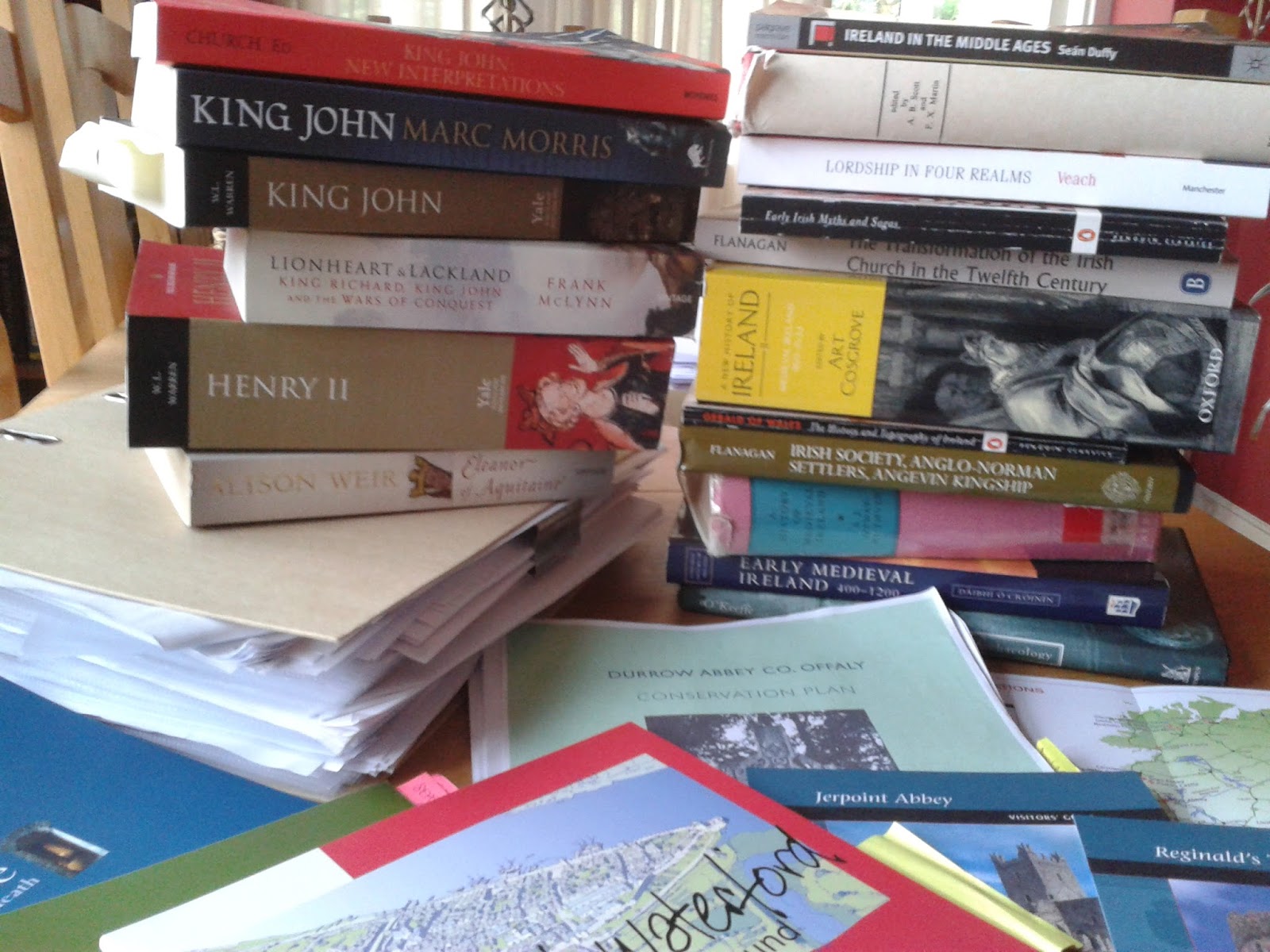
With regard to time scales, writing a novel takes many, many months, and with a historical novel even more so. When people ask 'Do you do a lot of research for your novel?', my answer is best summed up with this photo:

Research? Erm...
And for The Lord of Ireland, I did a lot of research on the ground, too. John's failed campaign in Ireland actually took place. Thanks to Henry II's royal clerk, Gerald of Wales, we know some of what happened and where John went. Most (in)famously, John landed at Waterford and proceeded to pull the beards of the Irish chieftains who came to greet him. Retracing John's footsteps brought a whole new level to my research. I told International Thriller Writers all about it recently- you can find my Guided Tour here.

Reginald's Tower, Co Waterford:
witness to beard-pulling.
But whatever research one does, however carefully crafted a plot, all is for nothing unless you have fully fleshed characters. Palmer and Theodosia are here again, which I'm sure/hoping will please readers. I hope they'll like the new ones too, for they were hugely enjoyable to write.

Many are real historical figures. Royal clerk Gerald, who travelled to Ireland with John, provided me with his own outrageous historical views on the Irish and I might (just might) have gotten my own back on him a few times. I've written about Gerald's questionable views on the Irish in a previous post on Medieval Ireland. He was also a great chronicler and I talk more about that in this post.

What Irish Women Get Up To- according to Gerald of Wales.
And no, they don't/didn't. 
Hugh de Lacy, Henry II's first Lord of Meath and a big threat to the King, is a major character. We have Gerald to thank for a physical description:
'What Hugh’s complexion and features were like, he was dark, with dark, sunken eyes and flattened nostrils. His face was grossly disfigured down the right side as far as his chin by a burn, the result of an accident. His neck was short, his body hairy and sinewy. He was a short man. His build- misshapen.'
Gerald goes on to tell us what a great fighter de Lacy is but that he's not to be trusted as he has taken a daughter of the Irish High-King, Rory O'Connor, as his second wife. Gold to a novelist, yes?

Interior of  Hugh de Lacy's Trim Castle, Co. Meath
De Lacy had a remarkable life and I've talked more about it in this post.

I had fun with my fictional characters, too. But the path doesn't always run smoothly with naming them. In despair one day, I sent this e-mail to another Irish writer, the wonderful and wise Kevin McMahon:
'My character is native Irish, a huge, battle-axe wielding warrior and a great fighter and I want to give him a single Irish that describes him. I also need to avoid the following letters that would start his name, as it can look clumsy on the page when people have the same one. So, to avoid: B, C, D, E, J (I know that’s out anyway in the Irish alphabet, along with K, Q, V, W, X, Y, Z, if memory serves me correctly), G, H, L, N, O, P, R (but might get away with this one), T.'
Despite my ridiculous parameters, Kevin came back with Uinseann, which means 'victor'. How wonderful and wise is that?

The native Irish, as depicted by Gerald of Wales.
Granted, Uinseann does actually do some of this.
And there is one character that without whom the book wouldn't exist, the Lord of Ireland himself. John, the future Bad King John. What can I say, except that I think I actually enjoy writing my villains more than my heroes. John's campaign started badly and went downhill from there. Gerald had expected the worst. He describe's John's decision to 'bypass the venerable church of St. David's' as he travelled to Ireland as a 'sinister omen for his expedition.' 

King John as depicted in Waterford's Great Charter roll c1372.
Sinister, indeed, but a gift for me. Sir Benedict Palmer awaits you in medieval Ireland. 

~~~~~~~~~~~~~~~~~~~~
The images from Gerald of Wales are in the the Public Domain and are part of the British Library's Catalogue of Illuminated Manuscripts. All other images are © E.M. Powell.

Tuesday, October 13

Hugh de Lacy: Anglo-Norman King of Ireland?

The 26th of July marks the anniversary of the death of one of Henry II's most successful lords, the Anglo-Norman Hugh de Lacy. De Lacy died on that day in 1186 at Durrow, now part of County Offaly, in the Republic of Ireland. His obituary in the Irish annals calls him "King of Meath, Bréifne and Airgialla".

De Lacy did not meet a peaceful end or even one in the heat of battle, where he might have been prepared. His was a brutal and sudden end, even by medieval standards: he was beheaded as he inspected his new castle at Durrow. So why was this Anglo-Norman knight referred to in such lofty terms, and what caused him to be so viciously cut down?

Hugh de Lacy- as drawn by Gerald of Wales
De Lacy was originally Lord of Weobley in Herefordshire. His father had joined the Knights Templar and had signed his lordship to Robert, his eldest son. Robert died childless, so Hugh inherited the title, which he had not expected to do, and became an important tenant of the crown. That wasn't enough to satisfy him. He married Rose of Monmouth, the widow of the powerful Baderon, increasing his prosperity. And he liked to acquire land, whether in England Wales or Normandy. he also had a rather unfortunate tendency to just take it.

The Chapel at Hugh de Lacy's Trim Castle, Co. Meath
We know quite a lot about de Lacy as a person, as Gerald of Wales, the famous chronicler at Henry II's court, wrote extensively of him. He was probably not the most handsome of men. Gerald's description certainly does not flatter: "What Hugh’s complexion and features were like, he was dark, with dark, sunken eyes and flattened nostrils. His face was grossly disfigured down the right side as far as his chin by a burn, the result of an accident. His neck was short, his body hairy and sinewy. He was a short man. His build- misshapen.'"Gerald even included a picture of him in his Conquest of Ireland. 

As for personality, Gerald tends to bounce from one opinion to another (and Gerald was always good for an opinion). He describes de Lacy as "resolute and reliable...restrained from excess by French sobriety. A man of great honesty and good sense." But less favourably when "after the death of his wife [Rose of Monmouth], he was a womanizer and enslaved by lust, not for just one woman, but for many."


The view from the top of Trim Castle
In 1171, de Lacy went with Henry II to Ireland. The Norman grip on the country was in the very earliest stages and there was a lot of what de Lacy liked up for grabs: land. The kingdom of Mide (Meath) was a particularly attractive prize and de Lacy made sure he won it. In a fight with the native Irish ruler, Tigernan Ua Ruairc, de Lacy was the victor. He achieved that victory through the beheading of Ua Ruairc, in an ominous foreshadowing of his own terrible end. Henry granted him Meath and gave him Dublin as well.

Trim Castle
De Lacy proved to be an invaluable asset in Ireland. Even Gerald is pleased: he says de Lacy 'made an excellent job of fortifying Leinster and Meath with castles."  Trim Castle, his seat in Meath, still stands today and is remarkable in its size and scale.

Staircase, Trim Castle
The trouble was, de Lacy was a bit too good at what he did- certainly as far as Henry was concerned. The King tried to clip de Lacy's wings, recalling him to England several times and granting the lordship of Ireland to Henry's own son, John, who was just nine years old at the time. But de Lacy was one step ahead. His first wife, Rose, had died around 1180. He married again, but this time he took an Irish wife, a daughter of the High-King Rory O'Connor (Ruaidri Ua Conchobair) of Connacht. Some records name this woman as Rose also, but this is likely to be a confusion.

The marriage of Strongbow & Aoife
Daniel Maclise, mid 19th century
This marriage was not well received by Henry. He had suspicions that de Lacy was attempting a strategic marriage in the same way that another of his men, Richard fitzGilbert de Clare (Strongbow) had done a decade earlier. Gerald certainly had a dim view of de Lacy's ambitions: "He was avaricious and greedy for gold and more ambitious for his own advancement and pre-eminence than was proper."


John, Lord of Ireland
Henry's solution was to send his son, John, now nineteen, to Ireland in 1185 to assert his authority as Lord of Ireland. John's mission, which started with him pulling the beards of the Irish dignitaries who came to greet him at Waterford, was not a success. He came back after nine months, complaining to his father that de Lacy had been conspiring against him. This is highly unlikely. John was more than capable of failures of his own making.

Whether de Lacy had designs on taking Ireland from Henry, we will never know, for his life was brutally cut short. On July 26th, 1186, de Lacy was inspecting his new castle at Durrow when he was murdered by a single assassin. Contemporary accounts tell us that the murderer had concealed an axe beneath his cloak, and he took de Lacy’s head off with one savage blow, and his head and body fell into the ditch of the castle.

Durrow today- the motte where de Lacy died is in the trees beyond.

The murderer was sent by a chieftain of Meath, Sinnach Ua Catharnaig, a man known as The Fox. Sinnach claimed that he ordered the murder to atone for the wanton destruction of land sacred to the great saint, Columcille, on which de Lacy had built his castle at Durrow. It's more likely that is was simple revenge. One of Sinnach’s sons was slain by Henry’s men some eight years ago, when Hugh de Lacy was the King’s representative in Ireland. Sinnach had always vowed to avenge that death.

Whatever the real motive, it solved a problem for Henry. The powerful threat that was Hugh de Lacy was no more. Chronicler William of Newburgh recorded that 'the news was gladly received by Henry.'

Saint Columcille's Well, Durrow
I visited various sites that relate to Hugh de Lacy when researching my novel of medieval Ireland, The Lord of Ireland. Durrow is a very quiet, beautiful place. I can see why anyone would chose to live there, as de Lacy did. And the well and the ancient high cross are still standing, just as they were the day he died, 829 years ago.

Durrow High Cross- ninth century
~~~~~~~~~~
References:
All photos are copyright E.M. Powell 2015.

Cosgrove, Art, ed: A New History of Ireland Volume II, Medieval Ireland: Oxford University Press (2008)
Durrow Abbey Conservation Plan, Office of Public Works, (2005)
Flanagan, Marie-Therese, Irish Society, Anglo-Norman Settlers, Angevin Kingship: Interactions in Ireland in the late 12th Century, Oxford: Clarendon Press (1998)
Oxford Dictionary of National Biography: Hugh de Lacy
Scott, A.B. & Martin, F.X. eds., The Conquest of Ireland by Giraldus Cambrensis: Dublin, Royal Irish Academy (1978)
Veach, Colin, A Question of Timing: Walter de Lacy's seisin of Meath 1189-94, proceedings of the Royal Irish Academy, Vol. 109C, pp. 165-194 (2009)
Veach, Colin, “Relentlessly striving for more”: Hugh de Lacy in Ireland, History Ireland, Issue 2, Volume 15 (2007)
~~~~~~~~~~
This post first appeared on the English Historical Authors Blog on 25th July 2015. I wrote it to coincide with the anniversary of Hugh de Lacy's death.


- See more at: http://www.bloggerhow.com/2012/07/implement-twitter-cards-blogger-blogspot.html/#sthash.Xcm5fXCr.dpuf