Showing posts with label Sir Benedict Palmer. Show all posts

Tuesday, April 5

How I Wrote My Novel of Medieval Ireland, The Lord of Ireland

Yes, it's April 5 2016. Not a red-letter day on the calendar for most, but for me, a very special day indeed. For today is the day that Book #3 in my Fifth Knight  medieval thriller series, The Lord of Ireland, is out. Yes, Sir Benedict Palmer is back- and this time he's off to Ireland!

Ta-da!
And here's what it's about:

England, 1185. John is a prince without prospect of a crown. As the youngest son of Henry II, he has long borne the hated nickname ‘Lackland’. When warring tribes and an ambitious Anglo-Norman lord threaten Henry’s reign in Ireland, John believes his time has finally come. Henry is dispatching him there with a mighty force to impose order. 
Yet it is a thwarted young man who arrives on the troubled isle. John has not been granted its kingship—he is merely the Lord of Ireland, destined never to escape his father’s shadow. Unknown to John, Henry has also sent his right-hand man, Sir Benedict Palmer, to root out the traitors he fears are working to steal the land from him. 
But Palmer is horrified when John disregards Henry’s orders and embarks on a campaign of bloodshed that could destroy the kingdom. Now Palmer has to battle the increasingly powerful Lord of Ireland. Power, in John’s hands, is a murderous force—and he is only just beginning to wield it.
Now, some people compare the writing and publishing of a novel to being pregnant. They often refer to the interminable time-scales, the waiting, the expectation, the preparation. I'd second (some of that), along with weight gain, mood swings and the desire for strange food.

With regard to time scales, writing a novel takes many, many months, and with a historical novel even more so. When people ask 'Do you do a lot of research for your novel?', my answer is best summed up with this photo:
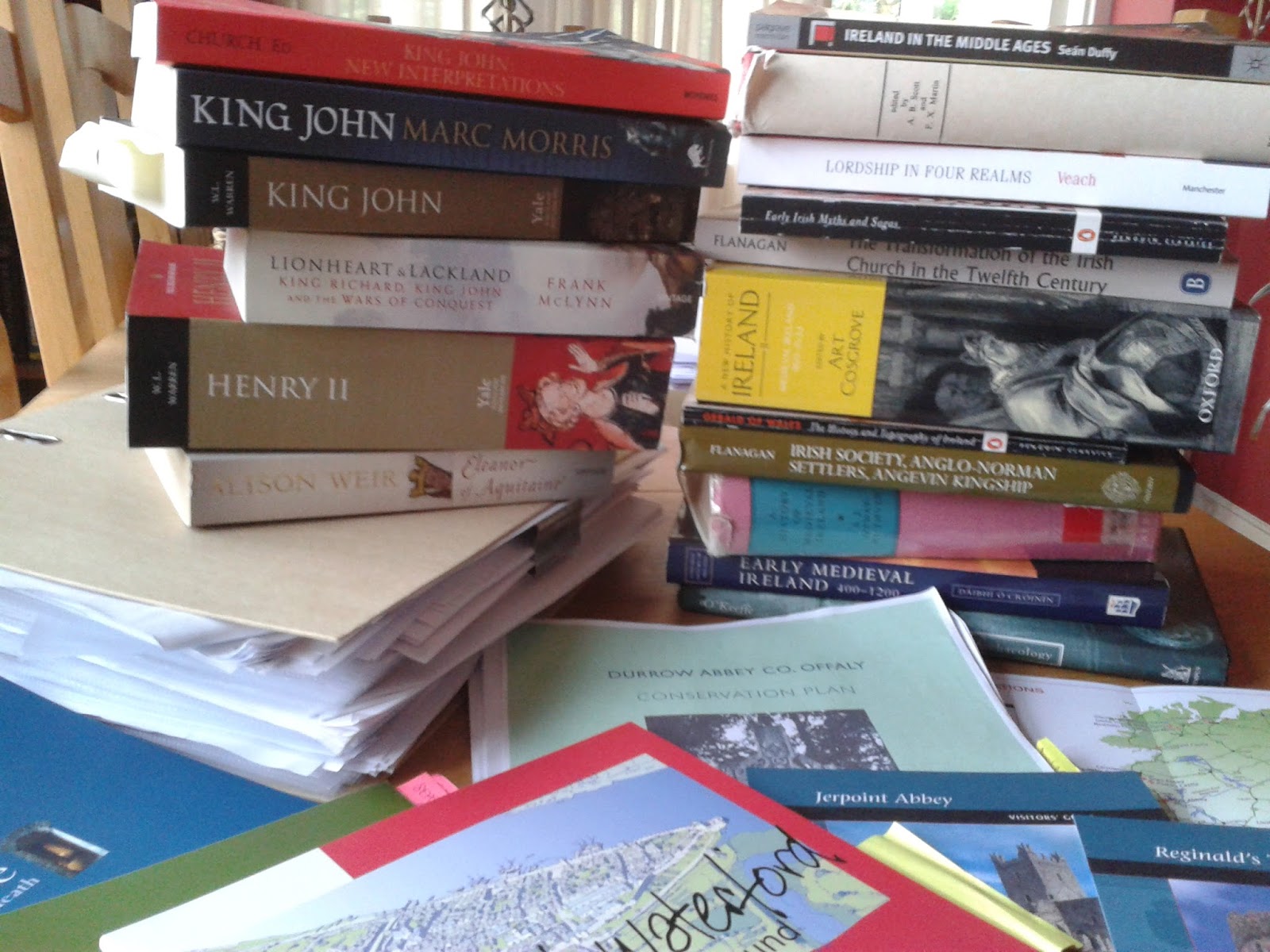
Research? Erm...
And for The Lord of Ireland, I did a lot of research on the ground, too. John's failed campaign in Ireland actually took place. Thanks to Henry II's royal clerk, Gerald of Wales, we know some of what happened and where John went. Most (in)famously, John landed at Waterford and proceeded to pull the beards of the Irish chieftains who came to greet him. Retracing John's footsteps brought a whole new level to my research. I told International Thriller Writers all about it recently- you can find my Guided Tour here.

Reginald's Tower, Co Waterford:
witness to beard-pulling.
But whatever research one does, however carefully crafted a plot, all is for nothing unless you have fully fleshed characters. Palmer and Theodosia are here again, which I'm sure/hoping will please readers. I hope they'll like the new ones too, for they were hugely enjoyable to write.

Many are real historical figures. Royal clerk Gerald, who travelled to Ireland with John, provided me with his own outrageous historical views on the Irish and I might (just might) have gotten my own back on him a few times. I've written about Gerald's questionable views on the Irish in a previous post on Medieval Ireland. He was also a great chronicler and I talk more about that in this post.

What Irish Women Get Up To- according to Gerald of Wales.
And no, they don't/didn't. 
Hugh de Lacy, Henry II's first Lord of Meath and a big threat to the King, is a major character. We have Gerald to thank for a physical description:
'What Hugh’s complexion and features were like, he was dark, with dark, sunken eyes and flattened nostrils. His face was grossly disfigured down the right side as far as his chin by a burn, the result of an accident. His neck was short, his body hairy and sinewy. He was a short man. His build- misshapen.'
Gerald goes on to tell us what a great fighter de Lacy is but that he's not to be trusted as he has taken a daughter of the Irish High-King, Rory O'Connor, as his second wife. Gold to a novelist, yes?

Interior of  Hugh de Lacy's Trim Castle, Co. Meath
De Lacy had a remarkable life and I've talked more about it in this post.

I had fun with my fictional characters, too. But the path doesn't always run smoothly with naming them. In despair one day, I sent this e-mail to another Irish writer, the wonderful and wise Kevin McMahon:
'My character is native Irish, a huge, battle-axe wielding warrior and a great fighter and I want to give him a single Irish that describes him. I also need to avoid the following letters that would start his name, as it can look clumsy on the page when people have the same one. So, to avoid: B, C, D, E, J (I know that’s out anyway in the Irish alphabet, along with K, Q, V, W, X, Y, Z, if memory serves me correctly), G, H, L, N, O, P, R (but might get away with this one), T.'
Despite my ridiculous parameters, Kevin came back with Uinseann, which means 'victor'. How wonderful and wise is that?

The native Irish, as depicted by Gerald of Wales.
Granted, Uinseann does actually do some of this.
And there is one character that without whom the book wouldn't exist, the Lord of Ireland himself. John, the future Bad King John. What can I say, except that I think I actually enjoy writing my villains more than my heroes. John's campaign started badly and went downhill from there. Gerald had expected the worst. He describe's John's decision to 'bypass the venerable church of St. David's' as he travelled to Ireland as a 'sinister omen for his expedition.' 

King John as depicted in Waterford's Great Charter roll c1372.
Sinister, indeed, but a gift for me. Sir Benedict Palmer awaits you in medieval Ireland. 

~~~~~~~~~~~~~~~~~~~~
The images from Gerald of Wales are in the the Public Domain and are part of the British Library's Catalogue of Illuminated Manuscripts. All other images are © E.M. Powell.

Tuesday, July 14

The Rock of Cashel: Marvel from Medieval Ireland

There are historical sites that are interesting. There are historical sites that are spectacular. And then there are historical sites that are an icon of the country in which they are located. It is in to the latter category that the Rock of Cashel in Co. Tipperary in the Republic of Ireland falls.

The Rock of Cashel
I've gone back to the land of my birth for my latest medieval thriller, The Lord of Ireland. I visited on a research trip in April 2015 (a hard job, but someone's got to do it!) which is when the photos in this post were taken. You might be surprised to see scaffolding on here. No, it isn't a medieval building project that has seriously overrun- I shall explain later.

The Rock of Cashel is also known as Saint Patrick's Rock.  The rock itself is an impressive prominent hill of karst limestone. This being Ireland, there is of course a far more imaginative description of what the rock is. Legend has it that the Devil took a bite out of the mountain opposite, and then dropped the rock from his jaws onto the plain. That's a lot more exciting then geology, but perhaps not quite as reliable.

Devil's Bit
Given the commanding position of the Rock, it is hardly surprising that the over-kings of Munster adopted it as their seat of power for hundreds of years. It is here that Saint Patrick is alleged to have converted the King of Munster, Aenghus, to Christianity in the 5th century AD. There is of course no proof of this. We do have a law tract from around 700 A.D. which refers to the King of Cashel controlling other Munster kings.

It was a king of Munster, Muirchertach Ua Briain, who gifted the Rock to the church in 1101. No buildings survive from the reign of the kings. The magnificent buildings that still stand are ecclesiastical and were constructed in the medieval period.

The Round Tower
The Round Tower is an architectural design that is unique to Ireland. The tower on the Rock is its oldest building. Originally a bell tower, it dates from around 1100.

Exterior of Cormac's Chapel
Next oldest is Cormac’s Chapel, built by a King of Desmond (part of Munster) and consecrated in 1134. It is the first example of Romanesque architecture in Ireland. It is Cormac's Chapel that is currently shrouded in scaffolding. Its stone roof has had to endure almost 900 years of Irish rain (and that's a lot of rain), and an urgent conservation project is under way. Basically, it's being dried out and I was told that's likely to be a seven year job in total.

Interior of Cormac's Chapel
Fortunately, you can still enter the Chapel with a guide. It is stunningly beautiful. Carved stone faces look down from the ceilings and the remains of brightly-painted frescoes which would have made the interior glow with colour can still be seen.

Ceiling of Cormac's Chapel
The twelfth century saw radical reform of the church in Ireland and the Synods (ecclesiastical councils) were held at Cashel. The first Synod in 1101 attempted to address marriage practices of the native Irish, which were deemed to be immoral. The second Synod of Cashel was held in 1171/72, under the auspices of Henry II and with the full backing of the Pope.

Carved Stone Sarcophagus
Henry had already added Ireland to his dominions. In 1171, he came in person (the first king of England to ever come to Ireland) and he stayed at Cashel for part of his visit. The Synod passed legislation to do with marriage, the payment of tithes, freed the church from lay control and introduced clerical privilege. In short, the Irish church was to operate in exactly the same way as the Church in England. The Irish Church, in existence for 700 years since the time of Saint Patrick, was ended on the very rock that bears his name.

The cathedral was built in the thirteenth century and added to over the centuries. Some sources claim that a cathedral was built here in 1169, and then replaced.

Exterior of Cathedral's South Transept
The Hall of the Vicars Choral was added by an archbishop in the fifteenth century. The Vicars Choral were a group of men appointed to sing during cathedral services and consisted of a mix of clergy and laity. Their quarters have been impressively restored.

The Hall of the Vicars Choral- Interior
The Rock of Cashel is of course deservedly one of the most visited sites on the Republic of Ireland, attracting around a quarter of a million visitors a year. One of those visitor's signatures is on display.

Elizabeth R
Yes, it's the signature of Queen Elizabeth II. Her State Visit to Ireland was the first made by a British monarch since the founding of the State in 1922. Her visit was a hugely important step in further reconciling the troubled history between the two countries. How apt that her visit included Cashel, the ancient seat of the Irish kings.

Celtic Cross at Cashel


References:
All photos are copyright E.M. Powell 2015.
Duffy, Seán, Ireland in the Middle Ages: Palgrave/Macmillan (1997)
Flanagan, Marie Therese, The Transformation of the Irish Church in the Twelfth Century, Boydell Press (2010)
Manning, Conleth, Rock of Cashel, OPW- The Office of Public Works/Oifig na nOibreacha
Ó Cróinín, Dáibhí, Early Medieval Ireland: 400-1200, Longman (1995)
O'Keefe, Tadhg, Medieval Ireland: An Archaeology, Tempus Publishing Ltd. (2000)
~~~~~~~~~~~~~~~
Note: I originally posted a version of this article on English Historical Fiction Authors on June 15th 2015.


Monday, May 19

Meet My Main Character Blog Hop

In this latest game of tag for historical fiction authors on the blogosphere, we introduce the main character of our work in progress or soon to be published novel. I’ve been tagged by Dianne Ascroft who talks about the characters in her fascinating World War II work-in-progress. You can read her post here. So time for me to rewind a further seven hundred-plus years to answer some questions about my current main character.

1. What is the name of your character? Is he/she fictional or a historical figure/person?

As my soon-to-be-published novel is the sequel to The Fifth Knight, my hero is once again mercenary knight, Sir Benedict Palmer. It was his first outing (and mine!) in the world of published fiction. And while he is fictional, many other characters and events are not. The sequel is called The Blood of The Fifth Knight and will be published by Thomas & Mercer on December 09 2014 (find it here!). Again, I've used real events to inspire the story.


2) When and where is the story set?

The story takes up exactly where The Fifth Knight ended. It's 1174 and King Henry II is doing his brutal penance on the streets of Canterbury for the murder of Thomas Becket. The King's throne is under threat from a rebellion, which puts Palmer and his family in danger too.

3) What should we know about him/her?


Aidan Turner- Palmer Nominee!
Readers of The Fifth Knight will know Palmer has got to where he is in life by talent as well as his quick wits. As for physical description, he's now in his late twenties, well-built with dark hair and eyes. That was as far as I went with his physical description. It was fun hearing from readers who suggested their own take on him. I think my favourite suggestion is Aidan Turner. Check out his IMDb page at  http://www.imdb.com/ (where this picture came from). You may be persuaded too!

4) What is the main conflict? What messes up his  life?

Palmer fought for and won the love of his life, the anchoress Theodosia. He wants to stay by her side and with his children. But Henry calls him back for a new mission. Someone is trying to murder Henry's beautiful young mistress, Rosamund Clifford. (She was a real person- she's often referred to as the Fair Rosamund in popular culture.) The King only trusts Palmer to root out who is responsible.

5) What is the personal goal of the character?

Palmer wants to solve the crime and get home to his family. But the attacks on Rosamund don't stop and things take a major turn for the worst for Palmer.

6) Is there a working title for this novel, and can we read more about it?

As I've said, the book is called The Blood of The Fifth Knight. Some one asked me if it means 'blood' as in family or 'blood' as in the red stuff getting spilled. Same answer here: you'll have to read to find out, and you'll be able to do that late in 2014!

I'm now tagging three more great Historical Fiction authors who will post their answers to these questions on Monday 26 may 2014. They are:


Judith Arnopp
Judith Arnopp is the author of several historical novels. In 2007 Judith Arnopp graduated from the University of Wales, Lampeter with a BA in English Literature and a Masters in Medieval Studies; she now combines those skills to write historical novels. She is currently working on a third Tudor novel Intractable Heart, the tale of Henry’s sixth and last wife, Katherine Parr.
Judith also blogs about the Tudor period, both on her own blog-page and on the English Historical Fiction Author’s website. Her work reaches a world-wide audience and her following is steadily increasing.

Elizabeth Kales
Elizabeth Kales is the author of The Silk Weaver's daughter. She began her career by writing television and radio advertising for the Canadian Broadcasting Corporation. Later she worked in the travel industry for many years and had numerous articles published in newspapers and trade journals. After spending time in France and England, she began to write her novels based loosely on the family history she had done for over twenty years. She currently lives in Western Canada with her husband and her cat.

Matthew Harffy
Matthew Harffy is writing a series of novels set in seventh century Northumbria. In his day job he is a manager of fifteen technical writers, so spends all day writing and editing, just not the words he’s most interested in! Prior to that he worked in Spain as an English teacher and translator. He has co-authored seven published academic articles, ranging in topic from the ecological impact of mining to the construction of a marble pipe organ. When not writing, or spending time with his family, Matthew sings in a rock band (http://www.rockdogband.co.uk).


The Fifth Knight is a #1 Bestselling Historical Thriller. Find it here on Amazon.com and here on Amazon.co.uk. The Blood of The Fifth Knight will be published by Thomas & Mercer on December 09 2014. Find it here!

- See more at: http://www.bloggerhow.com/2012/07/implement-twitter-cards-blogger-blogspot.html/#sthash.Xcm5fXCr.dpuf