Showing posts with label 12th century. Show all posts

Tuesday, November 27

Medieval Crime and Punishment: Henry II and the Common Law

King Henry II of England is best known in the popular imagination for the murder of Archbishop Thomas Becket, a murder for which the King was blamed. Four knights broke into Canterbury Cathedral on 29 December 1170 and slew Becket in the most brutal manner.

The Murder of Thomas Becket c 1480 Public Domain- British Library

Whatever one’s view of the volatile Henry, there is one achievement from his thirty-five-year reign that stands above all others: his reform of the English legal system, which laid the foundations of the English Common Law. When he came to the throne in 1154 at the age of just twenty-one, his realm was in deep disarray following civil war. He urgently needed to re-establish royal authority and impose order and set about doing so with his customary relentless drive. The judicial system was the subject of much of his attention and he was aided in this by the talented Becket, who was his chancellor at the time.

Henry II enthroned, arguing with Thomas Becket c. 1307 - c. 1327 Public Domain- British Library

Henry addressed reform of both land law and criminal law. With land law, cases relating to an individual being dispossessed or those in which inheritance was in dispute were now settled in a trial by jury. The jury system was far quicker and more efficient than the system it replaced. Given that said system was one of trial by combat, one can see why it was not just the efficiency of the new system that made it so popular.

His reform of criminal law was even more impressive. He issued new legislation at Clarendon in 1166 and Northampton in 1176. It was at Clarendon where the procedures of criminal justice were first established, addressing how serious felonies such as murder, robbery and theft would be dealt with. Juries of presentment were established, consisting of twelve lawful men in each hundred (a subdivision of a county) and four in each vill (village). These juries were not there to decide on guilt or innocence, but to support an accusation of a serious crime.

Anyone who was accused of such crimes would be put in prison to await trial. Those trials could only be heard by the King’s justices, who travelled the country to do so. Henry first introduced his system of itinerant justices at Clarendon but refined the system at Northampton. England was divided into six circuits, with three justices, the justices of the general eyre, allocated to each.  Twelfth century chronicler Roger of Howden lists the eighteen justices itinerant and their circuits for 1176.

Detail of an historiated initial 'I'(udex) of a judge c. 1360- c. 1375 Public Domain - British Library

One of the justices listed was Ranulf de Glanville. De Glanville was one of Henry’s staunchest allies, securing key victories for the King in the rebellion of 1173-74 and rising to the position of Justiciar of England. The ‘Treatise on the Laws and Customs of the Kingdom of England’, produced in the late twelfth century, is the earliest treatise on English law and is commonly referred to as ‘Glanvill’, though it is unlikely that de Glanville was its author.

The justices provided a system of criminal investigation for the whole country. The impact of the arrival of the travelling court should not be underestimated. It could consist of several hundred people, all of whom were tasked with supporting the royal justices in administering the law in the name of the lord King. As well as being administratively impressive, it would have been a spectacle that reinforced Henry’s power over all his subjects. It would also have instilled awe and fear in all those who witnessed it, especially those who were accused of a serious crime.

The accused were brought before the justices. Proof of their guilt or innocence could be established in a number of ways, such as witness testimony, documents or the swearing of oaths. Unlike criminal trials today, the jury acted as witnesses and not an impartial panel. They would give the account of what had happened.

Five judges and three plaintiffs c. 1360- c. 1375 Public Domain - British Library

In cases that were not clear cut or in those of secret homicide where there were no witnesses, the justices used the ordeal. Ordeal could be by cold water or by hot iron. The blessing of the water and the iron served to bring the notion of God’s judgement, judicium Dei, into the proceedings.

There was great ceremony and a long build-up attached to the ordeal, which would have added to the pressure on the accused to confess. The accused would be taken to church four days before the day on which the ordeal was due to take place. They had to wear the clothes of the penitent, fast and hear several masses. If they still did not confess, the ordeal would take place.

Two judges addressing a prisoner held by a court officer c. 1360-c. 1375 Public Domain - British Library

The most innocent of hearts must have quailed. Stripped to only a loin cloth, the accused would be led to the pit, which was twenty feet wide and twelve feet deep and full of water. A priest would then bless the water. God would now be the judge: His blessed water would receive the accused if innocent, reject him if he was guilty. The accused would be bound, thumbs to toes, and lowered in from a platform.

With ordeal by hot iron, the accused had to undergo the same preparation of fasting and penitence. A length of iron would be blessed and heated in a fire until it was red hot. The accused would have to take it in one hand and carry it for three paces. The injured hand would be bandaged and then examined three days after the ordeal. If it had healed, then innocence was proclaimed. If it had not, then the accused was guilty.

Both forms of ordeal were terrifying and horrific in themselves, and the lengthy preparations would have only added to the pressure to make a confession. Once the accused made a confession, it could not be retracted. In 1215, the Church forbade priests to take part in the ordeal, bringing an end to its use.

A man hanging from gallows c. 1360-c. 1375 Public Domain - British Library

For those found guilty, the King’s punishment awaited. Hanging was reserved for the worst crimes. Thieves and robbers could lose a foot and, from 1176, their right hand. The law also had a final judgement it could impose, even if the accused was acquitted by undergoing the ordeal. If it was judged that the accused had a particularly bad reputation, as sworn to by the jury, then the accused was to leave the King’s lands as an outlaw and had to swear under oath that they would never return.

And lest anyone think that they could take the law into their own hands and administer punishments themselves, the King’s justices had a clear system of heavy fines for those who would dare to do so. Order would prevail. Henry, the consummate administrator, had thought of everything.


References:
All images are in the Public Domain and are part of the British Library's Catalogue of Illuminated Manuscripts. 
Bartlett, Robert, Trial by Fire and Water: The Medieval Judicial Ordeal (Oxford, 1986)
Bartlett, Robert, The New Oxford History of England: England under the Norman and Angevin Kings 1075–1225 (Oxford, 2003)
Hudson, John, The Formation of the English Common Law (London, 1996)
Pollock, Frederick, and Maitland, Frederic William, The History of English Law Before the Time of Edward I (Cambridge, 1898)
Warren, W. L., Henry II (Yale, 2000)

~~~~~~~~~~
I wrote this post for the English Historical Fiction Authors blog where it was published on October 3, 2018.


Tuesday, November 1

Spreading the Word: Having a Novel Translated by Amazon Crossing

Every writer knows the amount of work that goes into a 100,000 word novel. The research, the plotting, the writing, the rewriting, the editing, the proofing, the cover design and more. All add up to many hundreds of hours before your story, that tale that started life in your head, becomes a reality and hits the electronic/physical book shops. Then comes the miracle of readers discovering what was in your head and even more miraculously, loving it. It’s all good. Your story is out there, and readers are reading it. Job done. On to the next.

But there are of course those readers who can’t discover your story. Those who speak a different language to yours, who read in it. They remain out of your reach as a writer.

Age-old problem: this fox doesn't speak Goose. Or Hen. 
So as a writer, the only way to bridge that gap is to have your novels published in translation. Happily for me, I got that very opportunity in January 2016, when the first novel in my medieval thriller Fifth Knight series, was published in Germany as Der fünfte Ritter. Even better, Der fünfte Ritter was published by Amazon Crossing, who are currently a global success story in translated genre fiction. Sir Benedict Palmer's first outing in German hit the Bild bestseller list. Now book two in the series, The Blood of the Fifth Knight, sees its release today as Das Blut des fünften Ritters.


Amazon Crossing invited me to Frankfurt Book Fair last month to talk about my experience in having my books translated. It was interesting that many of the questions I received at Frankfurt from German authors were exactly the same as those I received from those here in the UK. I thought I’d share the most common.


‘You’re having a book translated? How do you trust someone with your novel?’ 

I have to admit that this one surprised me the first time I was asked it. But as I get asked it more and more, it’s clearly something that bothers authors. It’s worth mentioning that we authors are very well known for our control freakery. Manuscripts often have to be prised from our cold, dead hands before we allow them to go through the editorial process. Part of the fear with translation is that we have very little control over what happens. We have to allow a professional translator to do their amazing job- but we have no way of checking up on them. I suspect that many scribes are coming out in hives even at the thought. But that’s the deal. If you want your work to be translated (and like me, don’t speak a word of the translated language) then you’re going to have to trust the translator.

Me at Frankfurt-where (thankfully!) 
my lovely audience were fine with me speaking in English.
My Amazon Crossing translator for both books has been the very wonderful Oliver Hoffmann. The perceptive amongst you will wonder how I know he’s wonderful. Aside from his consulting with me on my exact meaning from time to time, the answer lies in the reviews. I have had many great ones but also a few negative ones (yes, astonishingly: they do exist), which I’ve accessed via the wobbly Google Translate. I’m very pleased to report that those negative reviews were from readers who didn’t like my book. And here’s the thing: none of them cited poor translation.

With translated books, clunky translation almost always gets a mention and it puts other readers off. It also leads to lower ratings. So for those who may be going down the Indie route and are considering hiring a translator, consider it as just as an important investment as you did when you hired an editor, cover designer etc. A good translator is another professional who is going to help you put the best book out there.

‘Do you have the same covers as the English version?’

Short answer, no. Amazon Crossing produced their own covers for the German Editions. They know their market and what is likely to appeal. Asking which I prefer is too much of a Favourite Child question. But there is no doubt that the guy who has found his way onto Der fünfte Ritter is a big hit. Funnily enough, no one mentions language when they comment on him. Even my sister (otherwise known as The World’s Toughest Sell) refers to him as Mr. Broody.

Book Covers as seats at the Amazon stand- cool!
My book as a seat- even cooler!
One thing about cover design that is common to both Amazon Crossing in Germany and Amazon Publishing’s Thomas & Mercer in the UK is how much they consult on cover design. I do feel ever so slightly sorry for them when they send me a very eye-catching draft and I tell them that the sword has a flat pommel (the bobble on the end of the sword) where it should be round, or a shield that would be better used for jousting and could I please have a Norman kite shield instead. I always send them pictures of what I mean. To their credit, they pull out all the stops and said shields and swords are found. I’m only guessing, but I’ll bet at times they’re really dreading my emails. Pommelgate, anyone?


‘Do you feel frustrated that you can’t read your own book now that it’s in another language? I know I would!’

To a very minor extent. But, for me, a translated book of mine is no longer mine alone. The translator now tells my story, too, so it can’t be 100% me anymore. Oliver Hoffmann's name is on the cover along with mine, which is exactly how it should be. Translation is not just the swapping of language for another. It's a creative process in its own right.  Done well, it captures the nuances and colour and tone of the original. Translation is a collaboration that means my words are brought to a whole new audience.


We historical fiction authors pride ourselves on being able to bridge time. Thanks to translation, we can cross borders, too. And that’s a rather wonderful thing.

Saturday, August 13

Illuminated Manuscripts: Treasures from the Medieval Scribes

The word manuscript literally means ‘written by hand’ and medieval manuscripts refers to those books produced in Europe between about the fifth century and the late fifteenth century. Illuminated manuscripts are works which are decorated with a variety of pictures and ornamentation.

Psalm 27 from the Vespasian Psalter- 8th Century Kent.
It is the earliest surviving English biblical example of an initial with a narrative scene.

The word ‘illuminated’ comes from a usage of the Latin word illuminare in the sense of its meaning ‘to adorn’. Burnished gold was often used in the decorating of books from the 13th century onwards but the term ‘illuminated’ does not only apply to manuscripts where gold or silver is used. It applies more broadly to any manuscript that is more elaborately decorated than with simple coloured initials.

From the early writings of Saint Jerome (who died c.420) to around 1100, the vast majority of manuscripts were produced in the scriptoria or cloisters of abbeys and monasteries. They were primarily theological, liturgical and academic works.

The Lindisfarne Gospels- 8th Century
Written & illustrated probably by Eadfrith, bishop of Lindisfarne.

Prior to the time of Saint Jerome, manuscripts (such as those produced in Rome) were in scroll format and made of papyrus. The use of papyrus is problematic in that, as a material, it is more likely to break, especially if it is handled frequently. Early medieval scribes moved to the use of prepared animal skin, the material that we refer to as parchment or vellum. The format also underwent a significant change to that of the book or codex, with separate pages that can be turned, read in sequence and much more easily navigated by a reader.

Initial from the Howard Psalter & Hours- England,1310 -1320.
Clerics sing from a scroll, which contains musical notation. 

The codex didn’t only make life easier for readers. It also improved the lot of those who wrote and illustrated the manuscripts—our medieval scribes. It is much easier to write on the flat, stable surface of a page than on a lengthy, unrolled scroll. But it’s probably fair to say the ‘easier’ is a relative term. Even the preparation was laborious and demanded perfection. Producing fine vellum involved the soaking in lime and skilled, meticulous scraping and stretching of expensive calfskin. Inks such as oak gall and lampblack had to be produced. Guide lines had to be ruled with absolute precision.

Book of Hours- Oxford, 1240, written in & illuminated by William de Brailes.
It is the earliest surviving English Book of Hours.

Note that such precision also had to be achieved using a feather quill pen. Quill pens were introduced around the sixth century and replaced the reed pen. They were most commonly made from the flight feathers of geese but could also be made from swan, duck, crow, or even pelicans and peacocks. Most of the feather was removed and the end sharpened and slit so it could be filled with ink.  The sharpening of the nib was done at different angles, which would make pen strokes of differing thickness. Such careful nib-work didn’t last long. A scribe would have to trim it frequently with a quill-cutter to keep its sharpness.

A seated scribe from the Life of St Dunstan.
Canterbury- late 11th/early 12th Century

All that before the most challenging and skilled task of all: the writing and illustrating of the text. One can only deeply admire the concentration, dedication and sheer physical toll it must have taken, with scribes having no reading glasses, no electric light and no modern heating through freezing and damp winters.

The fruits of their labours, that are the decorations on medieval illuminated manuscripts, are of three main types. First, larger illustrations that can take up a whole page and /or miniatures or small pictures incorporated into the text. These usually illustrate or complement the content of the text.

A map of the whole known world from Ranulf Higden’s Polychronicon.
England, last quarter of the 14th century.

The second type are initial letters that contain scenes (known as historiated initials) or that have elaborate decoration. Again, these usually illustrate or complement the content of the text.

Historiated initial 'D'(omine) with a crowned Virgin and Child.
English Book of Hours, 1st quarter of the 15th century.

Third, we have borders and line-endings, which may have many detailed images/miniatures in them. These often do not relate directly to the text and can contain unusual figures.

Marginal illustration from the Gorleston Psalter- Norfolk, early 14th century.
How much do we love the medieval duck? 

And while the illuminations could serve to illustrate or to decorate, they also provided aids for contemplation and meditation for those reading them as part of their daily prayer and devotion. On another (very practical) level, the illustrations were useful markers for less literate readers to be able to navigate a lengthy manuscript. One does not have to be able to read to identify a picture of the Virgin Mary or one of the story of Adam and Eve.

Four scenes from the Book of Genesis, with three of Adam & Eve.
The Huth Psalter, England, late 13th century.

Although so many wonderful works were produced by men (and women) of the church, by 1100 this situation began to change. The production of manuscripts was no longer the preserve of the church, and secular scribes and illustrators rose in importance. This was in part due to the expansion of the content of manuscripts. Romances, chronicles, medical and other texts and aristocratic family trees all began to be produced. The rise of the universities and the increase in book ownership by the wealthy saw a thriving secular book trade in Paris and Bologna by the 13th century.

Guinevere questioning Lancelot about his love for her.
Lancelot du Lac, France, c.1316.

It was another university city, the city of Cologne, that was to trigger the start of the demise of the manuscript. By the 1470s Cologne had become the most important centre of printing in north-west Germany and where a certain William Caxton was perfecting his own particular art. Handwritten texts were being replaced by the printed version.

From the Arnstein Bible, a large two-volume MS, Germany c. 1172.
It was written by a single scribe, a monk named Lunandus.

But it was English Reformation that was to see the wanton destruction of the illuminated manuscript. Henry VIII decreed that the 'images and pictures' of Saint Thomas Becket shall 'through the whole realm be put down and avoided out of all churches, chapels, and other places.’ The Act against Superstitious Books and Images (1550) ordered that prayer and service books that did not comply with the reformed liturgy should be destroyed. The religious communities did their best to keep their handwritten treasures safe. Books were smuggled out of religious houses and hidden in sympathetic homes. But not all could be saved. Priceless manuscripts were torn up, burned, used to clean candlesticks, clean boots, stop up beer barrels and even deployed in the privies.

The martyrdom of Thomas Becket from the Harley collection-
a rare survival in an English context.
Netherlands, 3rd quarter of the 15th century.
           

Yet despite all of this appalling vandalism, medieval manuscripts have preserved for posterity the lion’s share of medieval painting. As Beal so beautifully puts it: ‘Books have a knack of surviving.’ It is our great good fortune that they do.


Detail of marginal images of apes with books.
France, 1318-1330.

~~~~~~~~~~~~~~~~
References:
All images are in the Public Domain and are part of the British Library's Catalogue of Illuminated Manuscripts. (This online resource is truly a treasure trove and I cannot recommend it highly enough.)
Beal, Peter, A Dictionary of English Manuscript Terminology 1450–2000: Oxford University Press, Current Online Version. (2011)
Brigstocke, Hugh, The Oxford Companion to Western Art: Oxford University Press, Current Online Version (2003)
Chilvers, Ian, The Oxford Dictionary of Art and Artists (4 ed.): Oxford University Press, Current Online Version (2014)
De Hamel, Christopher, A History of Illuminated Manuscripts (2nd ed.), London: Phaidon Press Ltd. (1994).
Kerr, Julie: Life in the Medieval Cloister, London, Continuum Publishing (2009)
Whittock, Martyn, A Brief History of Life in the Middle Ages: London, Constable & Robinson (2009)

I first wrote this post for the English Historical Fiction Authors Blog, where it was published on May 21 2016.

Tuesday, May 31

John 'Lackland', Lord of Ireland

I doubt if King John, youngest son of Henry II, needs much introduction. The 800th anniversary of his issuing of Magna Carta was celebrated only last year. Being referred to as Bad King John also tends to stick in people’s minds.  As for Robin Hood, I will say nothing.

Royal Mail Magna Carta Stamp.
© E.M. Powell

But I’d like to share one of the lesser known episodes in John’s life: his first campaign in Ireland. For on April 25, 1185, John landed at the port of Waterford on the south east coast with three hundred knights in tow. He hadn’t arrived as King John, but as the eighteen year old Lord of Ireland. No spoilers, of course, but John being John, all did not go well.

King John as shown on Waterford's Great Charter Roll c. 1370
© E.M. Powell

We need to rewind a little to understand why John went there in the first place. Because EHFA is such a wonderful, well-informed blog, you can read a detailed account of the reasons in this post from March 2016 here. The short recap is that Henry II first visited Ireland in 1171. He had already sent troops there and he wanted to stamp his authority on it. But by 1185 it was in a state of major unrest, with native Irish kings and Henry’s Anglo-Norman barons who had taken Irish lands fighting it out for power.

One of those barons was Hugh de Lacy, Henry’s first Lord of Meath. De Lacy had turned into a major thorn in Henry’s side, being far too good at his job for the King’s liking. Yes, de Lacy had taken the ancient kingdom of Meath (Mide) from the Irish and constructed many castles. But he’d also married a daughter of Ruaidrí Ua Conchobair (Rory O’Connor), the Irish High King. Some chroniclers suggest that de Lacy was lining up to take all of Ireland from Henry.

Hugh de Lacy's Trim Castle in Co. Meath.
© E.M. Powell

The King looked for a solution and believed he’d found it in John. He’d made the nine year old John Lord of Ireland at the Council of Oxford in 1177. Now that John was an adult, it was time for him to assume responsibility for the troublesome isle. One would think John would have been pleased. After all, he’d borne the nickname of ‘Lackland’ (given to him by Henry) for some time. Trouble was, John possibly had his sights set on the Holy Land. Its ruler, King Baldwin IV, was stricken with leprosy and the Patriarch of Jerusalem arrived in England looking for a prince to succeed him.

John’s desires were thwarted.  On the 18th March 1185, the Patriarch came before Henry’s Council at Clerkenwell for a decision. The decision was a refusal. John would not be going east, but west. He would be going to Ireland. Even worse news for John was that he would not be going as king. Yes, the title of Lord of Ireland was Dominus Hiberniaedominus being the title accorded to a king before he was actually crowned. But Pope Lucius III would not sanction it. John would remain under the superior lordship of the Angevin dominions. He was not to be independent of his father. Henry knighted John at Windsor on March 31st and sent him on his way.

The port  of Waterford today.
© E.M. Powell

Happily for us, Henry also included his royal clerk, Gerald of Wales, in the entourage and Gerald wrote an account of the expedition in his Expugnatio Hibernica (The Conquest of Ireland). I did mention earlier that all did not go well and it was so from pretty much the moment John’s boots met Irish soil. Still standing tall on Waterford’s quay is the medieval Reginald’s Tower, part of the old city’s fortifications which date from the time of the Vikings.

Reginald's Tower, Waterford City
© E.M. Powell

While the Tower would have looked a bit different in John’s day, we do know precisely what he did as he stood outside it. A group of powerful Irish chieftains came to pay tribute to him as Henry’s representative, greeting him as their lord. John’s response? Well, according to Gerald, John ‘pulled some of them about by their beards, which were large and flowing according to the native custom.’

Suitably angered and very unimpressed, the Irish made for the court of one of the Irish King of Thomond, Domnall Mór Ua Briain (Donal O'Brien), where they reported back to him and others on the insults and how John was ‘a mere youth…a stripling who only listened to youthful advice.’ Worse, they decided that rather than make peace with John, they would ‘plot to resist [John’s force]…guard the privileges of their ancient freedom’ with their lives, and ‘make pacts’ to resist him. Those ‘who had previously been enemies became friends for the first time.’


One of Gerald's depictions of the Irish.
British Library- Public Domain

Having alienated many of the Irish, John then began making grants of land to his own friends— land that loyal supporters of Henry already held. The result, according to Gerald, was that those who were dispossessed ‘went over to the side of the enemy.’ And John carried on. He set about establishing castles to take control of the land. We know from Gerald that there were three sites: Tibberaghny, in Co.  Kilkenny, Ardfinnan in Co. Tipperary and Lismore in Co. Waterford.

Slievenamon, Co. Tipperary, as viewed from the site at Tibberaghny.
© E.M. Powell

These speculative grants were a huge mistake, unleashing the ire of the likes of the powerful Ua Briain. Ua Briain had been one of the first to submit to Henry back in 1171, yet ‘the stripling’ John would receive nothing of the sort. Fierce fighting broke out and there were losses of life on both sides. John (or rather, his more able men) made a few gains, but his forces were well and truly routed in equal amounts by some of the native Irish kings. His less able men drank, caroused and fought with each other. When John failed to pay them, they deserted.

As with so many of his writings, Gerald can be accused of bias, for it was his Cambro-Norman kinsmen who made up the first wave of colonists in Ireland. Yet Roger of Howden is of the same view, listing selfish behaviour by John, non-payment of his armies and subsequent desertion and bad losses to the Irish.

The Comeragh Mountains, Co. Waterford.
© E.M. Powell

One would have thought that John would have accepted some responsibility for his failings. But no. Instead, he accused one of Henry’s men of treacherous dealings with the Irish. And that man of course was Hugh de Lacy. There is no suggestion that de Lacy did anything to interfere with John’s campaign. He was by now immensely powerful: Constable of Dublin, and still holding his own vast lordship of Meath. De Lacy did join John for part of his travels through Ireland. What is interesting is that while de Lacy witnessed several of John’s charters, none of them are John’s grants of lands to his friends. It is possible that de Lacy, hugely successful on the battlefield as well as on the diplomatic front, wanted nothing to do with John’s cronyism.

Ninth Century High Cross, Durrow, County Offaly.
© E.M. Powell

John’s campaign ended in Dublin where he stayed until returning to Henry in December 1185, after only eight months as Lord of Ireland. He complained bitterly to the King about the Irish and Hugh de Lacy, and squarely blamed de Lacy for his failure. If de Lacy was poised to make a bid for Ireland, we will never know. De Lacy was assassinated at Durrow, Co. Offaly in July 1186 by an Irish axe-man. Henry is said to have rejoiced at the news and made preparations to send John back to Ireland to assume control. A new Pope had agreed to John’s coronation.

It was not to be. John was mid-journey when news came of his brother Geoffrey’s death. Now just two sons remained: Richard and John. John was needed elsewhere. It would be another twenty four years before John would set foot in Ireland again. And by 1210, he would no longer be Lackland: he would be King John. But he still would not be the English King of Ireland. That would take more than 300 years and another Henry- Henry VIII.
~~~~~~~~~~~~~
References:
Church, S.D.: King John: New Interpretations, Boydell Press (1999).
Cosgrove, Art, ed: A New History of Ireland Volume II, Medieval Ireland: Oxford University Press (2008)
Duffy, Seán: Ireland in the Middle Ages: Palgrave Macmillan (1997)
Flanagan, Marie-Therese: Irish Society, Anglo-Norman Settlers, Angevin Kingship: Interactions in Ireland in the late 12th Century, Oxford: Clarendon Press (1998)
McLynn, Frank: Lionheart & Lackland: King Richard, King John and the Wars of Conquest: Vintage Books (2007)
Morris, Marc: King John: Treachery, Tyranny and the Road to Magna Carta: Hutchinson (2015)
Oxford Dictionary of National Biography: King John/Hugh de Lacy
Scott, A.B. & Martin, F.X. eds., The Conquest of Ireland by Giraldus Cambrensis: Dublin, Royal Irish Academy (1978)
Veach, Colin, “Relentlessly striving for more”: Hugh de Lacy in Ireland, History Ireland, Issue 2, Volume 15 (2007)
Warren, W.L., King John, Yale University Press (1981)
~~~~~~~~~~~~
Note: I wrote this post, or an edited version of it, for the English Historical Fiction Authors blog on April 25, 2016. 

Tuesday, April 5

How I Wrote My Novel of Medieval Ireland, The Lord of Ireland

Yes, it's April 5 2016. Not a red-letter day on the calendar for most, but for me, a very special day indeed. For today is the day that Book #3 in my Fifth Knight  medieval thriller series, The Lord of Ireland, is out. Yes, Sir Benedict Palmer is back- and this time he's off to Ireland!

Ta-da!
And here's what it's about:

England, 1185. John is a prince without prospect of a crown. As the youngest son of Henry II, he has long borne the hated nickname ‘Lackland’. When warring tribes and an ambitious Anglo-Norman lord threaten Henry’s reign in Ireland, John believes his time has finally come. Henry is dispatching him there with a mighty force to impose order. 
Yet it is a thwarted young man who arrives on the troubled isle. John has not been granted its kingship—he is merely the Lord of Ireland, destined never to escape his father’s shadow. Unknown to John, Henry has also sent his right-hand man, Sir Benedict Palmer, to root out the traitors he fears are working to steal the land from him. 
But Palmer is horrified when John disregards Henry’s orders and embarks on a campaign of bloodshed that could destroy the kingdom. Now Palmer has to battle the increasingly powerful Lord of Ireland. Power, in John’s hands, is a murderous force—and he is only just beginning to wield it.
Now, some people compare the writing and publishing of a novel to being pregnant. They often refer to the interminable time-scales, the waiting, the expectation, the preparation. I'd second (some of that), along with weight gain, mood swings and the desire for strange food.

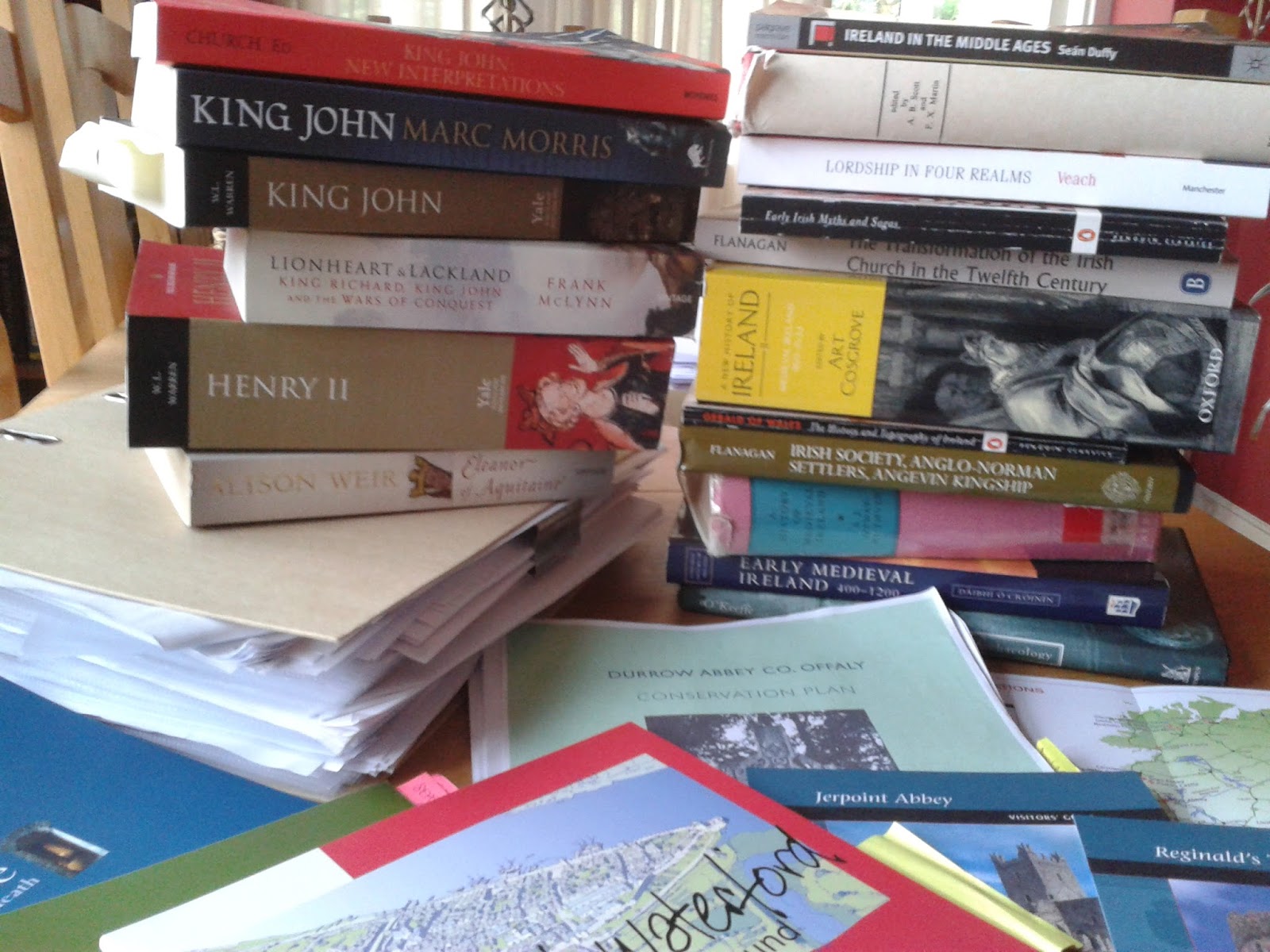
With regard to time scales, writing a novel takes many, many months, and with a historical novel even more so. When people ask 'Do you do a lot of research for your novel?', my answer is best summed up with this photo:

Research? Erm...
And for The Lord of Ireland, I did a lot of research on the ground, too. John's failed campaign in Ireland actually took place. Thanks to Henry II's royal clerk, Gerald of Wales, we know some of what happened and where John went. Most (in)famously, John landed at Waterford and proceeded to pull the beards of the Irish chieftains who came to greet him. Retracing John's footsteps brought a whole new level to my research. I told International Thriller Writers all about it recently- you can find my Guided Tour here.

Reginald's Tower, Co Waterford:
witness to beard-pulling.
But whatever research one does, however carefully crafted a plot, all is for nothing unless you have fully fleshed characters. Palmer and Theodosia are here again, which I'm sure/hoping will please readers. I hope they'll like the new ones too, for they were hugely enjoyable to write.

Many are real historical figures. Royal clerk Gerald, who travelled to Ireland with John, provided me with his own outrageous historical views on the Irish and I might (just might) have gotten my own back on him a few times. I've written about Gerald's questionable views on the Irish in a previous post on Medieval Ireland. He was also a great chronicler and I talk more about that in this post.

What Irish Women Get Up To- according to Gerald of Wales.
And no, they don't/didn't. 
Hugh de Lacy, Henry II's first Lord of Meath and a big threat to the King, is a major character. We have Gerald to thank for a physical description:
'What Hugh’s complexion and features were like, he was dark, with dark, sunken eyes and flattened nostrils. His face was grossly disfigured down the right side as far as his chin by a burn, the result of an accident. His neck was short, his body hairy and sinewy. He was a short man. His build- misshapen.'
Gerald goes on to tell us what a great fighter de Lacy is but that he's not to be trusted as he has taken a daughter of the Irish High-King, Rory O'Connor, as his second wife. Gold to a novelist, yes?

Interior of  Hugh de Lacy's Trim Castle, Co. Meath
De Lacy had a remarkable life and I've talked more about it in this post.

I had fun with my fictional characters, too. But the path doesn't always run smoothly with naming them. In despair one day, I sent this e-mail to another Irish writer, the wonderful and wise Kevin McMahon:
'My character is native Irish, a huge, battle-axe wielding warrior and a great fighter and I want to give him a single Irish that describes him. I also need to avoid the following letters that would start his name, as it can look clumsy on the page when people have the same one. So, to avoid: B, C, D, E, J (I know that’s out anyway in the Irish alphabet, along with K, Q, V, W, X, Y, Z, if memory serves me correctly), G, H, L, N, O, P, R (but might get away with this one), T.'
Despite my ridiculous parameters, Kevin came back with Uinseann, which means 'victor'. How wonderful and wise is that?

The native Irish, as depicted by Gerald of Wales.
Granted, Uinseann does actually do some of this.
And there is one character that without whom the book wouldn't exist, the Lord of Ireland himself. John, the future Bad King John. What can I say, except that I think I actually enjoy writing my villains more than my heroes. John's campaign started badly and went downhill from there. Gerald had expected the worst. He describe's John's decision to 'bypass the venerable church of St. David's' as he travelled to Ireland as a 'sinister omen for his expedition.' 

King John as depicted in Waterford's Great Charter roll c1372.
Sinister, indeed, but a gift for me. Sir Benedict Palmer awaits you in medieval Ireland. 

~~~~~~~~~~~~~~~~~~~~
The images from Gerald of Wales are in the the Public Domain and are part of the British Library's Catalogue of Illuminated Manuscripts. All other images are © E.M. Powell.

Wednesday, February 24

Who's Who in the Medieval Monastery

In around 530 A.D, the Roman Christian, Benedict of Nursia, sickened by the sinfulness of Rome, decided to live apart from the world as a hermit. And he wasn’t just apart: one of his early holy dwellings was a cave half-way up a cliff face. Although a community grew up around him and he established a group of monasteries, it’s doubtful that he could have envisaged just how popular his vision for monastic life was to become.


By the medieval period, those who inhabited monasteries made up a substantial section of the population. It has been estimated that by 1348, some thirty thousand people lived a full-time religious life in England, with two percent of adult males being clergymen. Most houses were male, but around two thousand women lived in one hundred and fifty nunneries.


Much in monastic life had evolved over the centuries, including how it was ordered by, and for, those who lived it. According to the Rule of Saint Benedict, the abbot was to be seen as the father of his monastic family and had ultimate authority in the running of his holy house. He was to be obeyed in all matters. The abbot was indeed the head of the medieval monastic community. And by medieval times, he also got the best food.

Many monasteries owned huge amounts of land and running it profitably became the abbot’s responsibility. The chronicles of monastic houses recorded ‘bad’ abbots whose mismanagement caused debt or loss of land. Those who had been successful in running the estate were deemed to have been virtuous.


Such an undertaking was complex and demanding, so a number of monks were appointed to hold offices or ‘obediences’ to assist the abbot and were known as ‘obedientiaries.’  Deputy to the abbot was usually the prior. (In a priory, the prior is the superior.) As the abbot would have to travel, often for weeks or even months at a time, so the role of day-to-day running of the monastery fell increasingly to the prior.


Another obedientiary was the cellarer, responsible for seeing that sufficient food and drink was available. This meant extensive dealings with outside tradesmen and those on the monastic estate who produced food. The food rent attached to Ramsey Abbey in Nottinghamshire in around 1000 A.D. consisted of 80 bushels of malt (for brewing), 40 bushels of oatmeal, 80 bushels of flour (for bread), eight sides of bacon, sixteen cheeses and two fat cows. Eight salmon were required in Lent. Yet this was only enough to feed the monks and servants of a large monastery for a week or two. In Wales, food rents consisted of loaves of bread, oats, cattle, sheep, pigs, butter, ale and honey. The cellarer also had the headache of feeding the large numbers of visitors who would pass through the monastery.


The sacrist had charge of the vestments and sacred vessels (including the corporals), while the precentor directed the church services. The corporals are pieces of linen on which the bread and wine are placed and consecrated in the Eucharist. The sacrist would launder these and there is an account of the sacrist at the London Charterhouse hanging the corporals on the lavender bushes to freshen them.


Timekeeping also fell to the sacrist. He would ring a bell or strike a board to wake his fellow monks in the (very early) morning, to assemble for prayer or to gather for a meeting. Without a mechanical clock (which did not make an appearance until the late thirteenth century), the sacrist might use a candle clock, a water clock, a sundial or rely on the position of the stars. Norwich Cathedral Priory acquired one of the earliest mechanical clocks in the 1270s but they were hugely costly.

The infirmarer cared for the sick but maintained the health of the well, too.  Bloodletting was performed on healthy members of religious communities at regular intervals throughout the year. It is described in monastic customaries and mentioned in visitation records and account rolls. It took place in groups and was quite a social occasion with the added advantage of plenty of good food and the chance to sleep in the infirmary after.


The infirmary was a place of warmth and comfort. Music might be played and prayer was considered an essential part of recovery. Injuries such broken bones, scalds and burns had to be treated in the infirmary as well as disease. When mental ill health occurred, it was often considered to be demonic possession. Behaviours such as uncontrolled raving or blaspheming called for Satan to be banished or expelled from the individual. Again, it was believed that such occurrences could be countered with prayer. But very little could counter the sickness that came calling to almost every monastery in England in 1348. The plague killed almost two-thirds of their inhabitants, the close proximity in which people lived helping the spread of the deadly disease.


The almoner was the monk who carried out charitable acts on behalf of the holy house and looked after the poor of the neighbourhood. His duty was to distribute alms for those deemed fit to receive them.

The majority of the monastic community consisted of choir monks or nuns whose days and nights were centred on the liturgy. Anyone wishing to become a monk had to first undergo a probationary period known as the novitiate. The novitiate could last up to a year but many novices completed only a few weeks before their acceptance.


The novice master had charge of the novices, a responsibility with challenges all of its own. One can hear the frustration of 14th century novice master Henry of Kirkstead: ‘novices acquire years sooner than understanding.’


Once they completed their novitiate, the novices were professed as monks and made full members of the community. The ceremony to receive them into the brotherhood took place in front of the entire community. Each of them made a will. Then the sacrist had another duty to perform: the new monk was given a tonsure.

The tonsure is of course the part of a monk's or priest's head left bare on top by shaving off the hair. The familiar image of the medieval monk bears the tonsure of Saint Peter: either a circular patch on the crown, or the whole upper part of the head so as to leave only a fringe or circle of hair. There are other types. In the Eastern Church the whole head is shaven (the tonsure of St Paul). In the ancient Celtic Church, the head was shaved in the front of a line drawn from ear to ear, which is the tonsure of St John.


Many of the new monks went on to take Holy Orders and become priests. Lay brothers, however, did not. Lay brethren took vows of obedience and were required to observe various liturgical Offices but unlike the monks, their day was centred on manual labour. They farmed the land, reared livestock and did building and repair work. They wore work clothes rather than habits and did not receive the tonsure. Their work was supported by other non-religious servants.

Monks were often known by where they came from, such as Hugh of Durham. Others were numbered. Thorney Abbey had a Jocelin I, a Jocelin II and a Jocelin III.


One would not perhaps expect to find a child in a monastery. But children sometimes were gifted to the community and were known as oblates. A younger son of a nobleman who would not inherit his father’s land and/or title might have met such a fate. Oblates received an education until the age of seventeen, then took their vows. The practice flourished in the eleventh century but was phased out during the twelfth and prohibited at the Fourth Lateran Council of 1215.


The last group to find shelter within a monastery’s walls were its visitors. They included patrons. The monasteries were closely bound in to the secular elites, who patronised a monastery as a matter of family prestige, to ensure that they would be remembered in the monks’ prayers and buried in an honoured place in the church. Relatives of the brethren, as well as visiting monks and other travellers would also seek accommodation. And, of course, pilgrims. Making a gift or a donation to a monastery would allow the pilgrim to be let off a penance. By the thirteenth century, one could acquire, for the right sum, indulgences for souls in purgatory.

One can only wonder what Saint Benedict, living in his isolated cave, would have thought.
~~~~~~~~~~~~
References:
All images are in the Public Domain and are part of the British Library's Catalogue of Illuminated Manuscripts. 
Dyer, Christopher: Making a Living in the Middle Ages, Yale University Press (2002)
Jones, Terry & Eriera, Alan: Medieval Lives, London, BBC Books (2004)
Kerr, Julie: Life in the Medieval Cloister, London, Continuum Publishing (2009)
Knowles, Elizabeth, ed.: The Oxford Dictionary of Phrase and Fable (2 ed.) Oxford University Press (2005, Current Online Version: 2014)
Livingstone, E.A.,ed.:The Concise Oxford Dictionary of the Christian Church (2 rev.ed.), Oxford University Press (2006, Current Online Version: 2013)
Mortimer, Ian. The Time Traveller's Guide to Medieval England. London: The Bodley Head. (2008)
~~~~~~~~~~~
Note: I wrote this post or an edited version of it for the English Historical Fiction Authors blog. It was published there on January 19 2016. 
- See more at: http://www.bloggerhow.com/2012/07/implement-twitter-cards-blogger-blogspot.html/#sthash.Xcm5fXCr.dpuf