Showing posts with label Ireland. Show all posts

Wednesday, September 30

Polygamy, Divorce & More: The Unusual Marriage Customs of Medieval Ireland


If one is asked to think of a country that historically had liberal marriage laws one doesn’t immediately think of Ireland. Yes, Irish voters decisively voted in favour of marriage equality in May 2015, making Ireland the first country to do so through the ballot box. But Ireland is also the country that did not make divorce legal until 1997, a country in which one of the members of its Dáil (Parliament) bemoaned famously in the 1960s that “There was no sex in Ireland before television.”

Yet if we rewind back well over a thousand years, we find things were very different. Ireland’s legal system consisted of two types of law: canon (church) law, and the secular brehon law. Secular law tracts on marriage were written around 700 A.D. Cáin Lánamna, ‘The Law of Couples’, describes the many types of union in marriage permitted. There is permanent, semi-permanent and transitory.


Another text categorizes married women into five classes. Three classes are those women who legitimately form formal unions. The other two are more open and include the marriage of wandering mercenaries. And it was permissible not to stop at just one wife. Though it’s debatable whether one should describe such unions as polygamy or a type of constantly shifting monogamy, the practice of concubinage, or subsidiary marriage, was also tolerated. The law also gave inheritance rights to the children of these unions.

But The Law of Couples doesn’t just address the joining of man and wife: it also addresses how they can be put asunder. Yes, the early Irish had a detailed law for divorce. While it allowed men a long list of reasons, it also gave women fourteen grounds for divorce. These could include wife-beating, failure of maintenance and homosexuality. Early Irish women could not be said to be emancipated, but they certainly fared better in marital law than their European counterparts.


In many respects, marriage practices in Ireland in 700 AD may not have been so different for the rest of Europe. But as canon law developed over the centuries, shaping marriage into its more rigid arrangements, Ireland held on to its own practices under secular law. These were increasingly frowned upon. In 1074, Archbihsop Lanfranc of Canterbury wrote to the Irish kings, describing the marital unions in Ireland a as “abominable exchanges.” Even Bernard of Clairvaux chimed in. In his Life of Saint Malachy, he describes Malachy being sent “not to men but to beasts.”

By the 12th century, the Irish church embarked upon a huge programme of reform, reform which had the behaviour of the Irish people firmly in its sights. One: it wanted to address the high levels of killing and violence in Ireland. Two: Irish marriage practices had to be addressed.


There were three aspects that the Synod of Cashel tried to tackle in 1101. Consanguinity, or prohibited marriages due to kinship, was one. Some of the pronouncements seem a little excessive: “No man in Ireland shall have to wife his grandfather’s wife.” It’s difficult to imagine when this particular situation would arise. But the complexities around consanguinity meant that many Irish marriages were now deemed to be incestuous.  The church was equally unhappy with divorce and remarriage, and of course subsidiary marriages. Yet the practices continued.

As the twelfth century progressed, Irish marriage practices came under renewed fire from external sources. Gerald of Wales, chronicler of England’s Henry II, wrote that “[The Irish] are a filthy people, wallowing in vice….they do not contract marriages. They do not avoid incest.”


Pope Alexander wrote to Henry II in 1172, advising that the Irish married their stepmothers, were not ashamed to have children with them and that a man might live in concubinage with two sisters. The different practices in Ireland had ceased to be merely different and now were viewed as barbarous.

Henry II’s invasion of Ireland was in part sanctioned by the Pope so that the moral and sexual laxity of the Irish could be dealt with. The Irish church in turn welcomed his support. It was a move that was to have the most far-reaching and tragic implications in the history of Ireland, a history that could be said to have been shaped by its customs. 
~~~~~~~~~~~~~~~~~~~
All photos in post © E.M. Powell 2015

This post was originally written for the English Historical Fiction Authors Customs blog hop.


Tuesday, July 14

The Rock of Cashel: Marvel from Medieval Ireland

There are historical sites that are interesting. There are historical sites that are spectacular. And then there are historical sites that are an icon of the country in which they are located. It is in to the latter category that the Rock of Cashel in Co. Tipperary in the Republic of Ireland falls.

The Rock of Cashel
I've gone back to the land of my birth for my latest medieval thriller, The Lord of Ireland. I visited on a research trip in April 2015 (a hard job, but someone's got to do it!) which is when the photos in this post were taken. You might be surprised to see scaffolding on here. No, it isn't a medieval building project that has seriously overrun- I shall explain later.

The Rock of Cashel is also known as Saint Patrick's Rock.  The rock itself is an impressive prominent hill of karst limestone. This being Ireland, there is of course a far more imaginative description of what the rock is. Legend has it that the Devil took a bite out of the mountain opposite, and then dropped the rock from his jaws onto the plain. That's a lot more exciting then geology, but perhaps not quite as reliable.

Devil's Bit
Given the commanding position of the Rock, it is hardly surprising that the over-kings of Munster adopted it as their seat of power for hundreds of years. It is here that Saint Patrick is alleged to have converted the King of Munster, Aenghus, to Christianity in the 5th century AD. There is of course no proof of this. We do have a law tract from around 700 A.D. which refers to the King of Cashel controlling other Munster kings.

It was a king of Munster, Muirchertach Ua Briain, who gifted the Rock to the church in 1101. No buildings survive from the reign of the kings. The magnificent buildings that still stand are ecclesiastical and were constructed in the medieval period.

The Round Tower
The Round Tower is an architectural design that is unique to Ireland. The tower on the Rock is its oldest building. Originally a bell tower, it dates from around 1100.

Exterior of Cormac's Chapel
Next oldest is Cormac’s Chapel, built by a King of Desmond (part of Munster) and consecrated in 1134. It is the first example of Romanesque architecture in Ireland. It is Cormac's Chapel that is currently shrouded in scaffolding. Its stone roof has had to endure almost 900 years of Irish rain (and that's a lot of rain), and an urgent conservation project is under way. Basically, it's being dried out and I was told that's likely to be a seven year job in total.

Interior of Cormac's Chapel
Fortunately, you can still enter the Chapel with a guide. It is stunningly beautiful. Carved stone faces look down from the ceilings and the remains of brightly-painted frescoes which would have made the interior glow with colour can still be seen.

Ceiling of Cormac's Chapel
The twelfth century saw radical reform of the church in Ireland and the Synods (ecclesiastical councils) were held at Cashel. The first Synod in 1101 attempted to address marriage practices of the native Irish, which were deemed to be immoral. The second Synod of Cashel was held in 1171/72, under the auspices of Henry II and with the full backing of the Pope.

Carved Stone Sarcophagus
Henry had already added Ireland to his dominions. In 1171, he came in person (the first king of England to ever come to Ireland) and he stayed at Cashel for part of his visit. The Synod passed legislation to do with marriage, the payment of tithes, freed the church from lay control and introduced clerical privilege. In short, the Irish church was to operate in exactly the same way as the Church in England. The Irish Church, in existence for 700 years since the time of Saint Patrick, was ended on the very rock that bears his name.

The cathedral was built in the thirteenth century and added to over the centuries. Some sources claim that a cathedral was built here in 1169, and then replaced.

Exterior of Cathedral's South Transept
The Hall of the Vicars Choral was added by an archbishop in the fifteenth century. The Vicars Choral were a group of men appointed to sing during cathedral services and consisted of a mix of clergy and laity. Their quarters have been impressively restored.

The Hall of the Vicars Choral- Interior
The Rock of Cashel is of course deservedly one of the most visited sites on the Republic of Ireland, attracting around a quarter of a million visitors a year. One of those visitor's signatures is on display.

Elizabeth R
Yes, it's the signature of Queen Elizabeth II. Her State Visit to Ireland was the first made by a British monarch since the founding of the State in 1922. Her visit was a hugely important step in further reconciling the troubled history between the two countries. How apt that her visit included Cashel, the ancient seat of the Irish kings.

Celtic Cross at Cashel


References:
All photos are copyright E.M. Powell 2015.
Duffy, Seán, Ireland in the Middle Ages: Palgrave/Macmillan (1997)
Flanagan, Marie Therese, The Transformation of the Irish Church in the Twelfth Century, Boydell Press (2010)
Manning, Conleth, Rock of Cashel, OPW- The Office of Public Works/Oifig na nOibreacha
Ó Cróinín, Dáibhí, Early Medieval Ireland: 400-1200, Longman (1995)
O'Keefe, Tadhg, Medieval Ireland: An Archaeology, Tempus Publishing Ltd. (2000)
~~~~~~~~~~~~~~~
Note: I originally posted a version of this article on English Historical Fiction Authors on June 15th 2015.


Tuesday, March 17

Medieval Ireland

Lá Fhéile Pádraig sona daoibh- Happy Saint Patrick's Day to you all! Yes, it's the day when much of the globe celebrates all things Irish by a) donning green and b) taking leave of their senses. Fair enough. As an Irish person, it's nice to see that the small island from which I hail is so widely/wildly celebrated, and I was very pleased that I could snag today's posting date to add to the acclaim.

Letter P Detail of decorated initial 'P'(lacuit). 
Much has been written about Ireland's history, but not many people are aware of a history of Ireland that was written in the 12th century, Topographia Hiberniae, or The History and Topography of Ireland. It was written by Gerald of Wales, a cleric and chronicler at the court of England's Henry II. (In case anyone's disappointed, please be assured that there will be snakes.) Gerald also included helpful illustrations: the manuscript images in this post are all his.

Partly Anglo-Norman and partly Welsh and a member of the hugely powerful and successful fitzGerald family, Gerald wrote seventeen books and planned several others. He wrote the Topographia following two visits to Ireland in 1183 and 1185. It is a remarkable work, shedding light on many aspects of medieval Irish life and society. However, it is at all times Gerald's light, and Gerald was on the side of the conquerors. Bearing that in mind, let's look at the Ireland of 850 years ago from a man who was there.

Initial 'L'(oqui) and a partially damaged map of islands
including Ireland (labelled 'Hybernia') and 'Britannia' 
Gerald divided his book into three parts. the first part he called The Position of Ireland. For the medievals, Ireland was the most westerly point in the world. Sorry, Americas, but there was simply nothing else. As Gerald so beautifully puts it: " Beyond these limits, there is no land, nor is there habitation either of men or beasts- but beyond the whole horizon only the ocean flows and is borne on in boundless space." He describes Ireland as about half the size of "greater Britain and ...more round."

Ireland's natural resources greatly impressed Gerald. He writes of rivers of magnificent size, with their "abundance of fish...beautiful lakes full of fish of magnificent size...a kind of speciality here." 

Detail of a miniature of an osprey diving for fish.
The fertile land and the mild temperatures, along with the ease with which grass could be grown also pleased Gerald: "The grass is green in the fields in winter, just the same as in summer." But like so many visitors to Ireland, Gerald quickly found out what made all that green in the first place: the Irish weather. (Or as we natives like to call it, the rain.) Gerald is not happy: "[The harvest] can scarcely be reaped...because of the unceasing rain. For this country more than any other suffers from storms of wind and rain... There is such a plentiful supply of rain, such an ever-present overhanging of clouds and fog, that you will scarcely see even in the summer three consecutive days of really fine weather." 


Snake!
Gerald was cheerier about the plentiful supply of birds and the lack of mammals that would pose a threat to man. He even mentions snakes, (I did promise), or rather, lack of them. He assures us that "Ireland has no serpents or snakes, toads or frogs, tortoises or scorpions."  His readers will also have been relieved to know "It has no dragons." For those of you waiting to see if Gerald has the definitive answer on Saint Patrick and the snakes issue, Gerald provides one. But you may be disappointed: "Some indulge in the pleasant conjecture that Saint Patrick...purged the island of all harmful animals. But it is more probable that from the earliest times...the island was naturally without these as well as other things." 


Spider
The first part of the Topographia is a wonderful read, in that so much of it is recognizable as the Ireland that still exists. The second part is also remarkable but in a way that is less based in reality. In it, Gerald relates The Wonders and Miracles of Ireland.

Fish & Deer With Golden Teeth.
Under Wonders, we have reports of a small island where corpses don't rot. A bearded woman with a mane on her back at the court of the King of Limerick. A priest who conversed at length with a wolf. A whale that was found with three gold teeth. Wonders, indeed, but the lake that was formed in a flood because the people were addicted to bestiality is probably the show stopper.

Women mating with animals.
Moving swiftly onto Miracles, Gerald includes (among many others), the fleas banished by Saint Nannan, a cross in Dublin that speaks the truth and the inextinguishable fire of Saint Brigid. My personal favourite is The Mill that Women Do Not Enter. The mill in question was carved by Saint Féchín, and women weren't allowed in. But an archer of Hugh de Lacy (de Lacy was Henry's man) dragged a woman in "and lustfully violated her there."  Happily, according to Gerald, the archer was "stricken in his member with hell-fire in sudden vengeance and immediately began to burn throughout his whole body. He died that same night." Good for Saint Féchín, I say. 


A stag, a hare, a badger & a beaver. 
The third part of the Topographia is where Gerald gets up close and extremely personal with the Irish people. Its title is The Inhabitants of the Country. One gets a sense of what is to come when he begins it by restating the legitimate claim that the kings of Britain have over Ireland. Following a brief mention of "beautiful, upright bodies and handsome and well-complexioned faces", there are positives no more.

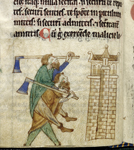
Firstly, the Irish are "barbarous..and cannot be said to have any culture. they are a wild and inhospitable people...they live on beasts only and live like beasts." Secondly, they are lazy, "think that the greatest pleasure is not to work and that the greatest wealth is to enjoy liberty." Gerald really gets into his stride with the third national trait, which is incest: "This is a filthy people, wallowing in vice." Fourth has us always treacherous, and he warns "You must be more afraid of their wile than their war." The fifth is the tendency to "always carry an axe as if  it were a staff...beyond being raised a little, it inflicts a mortal blow."  


Man killing another with an axe.
If only it were some nifty axe-work we were accused of. Gerald has more. He cites the example of a new and outlandish way of confirming kingship by the Irish in Ulster (where he never went). A white mare is brought before the ruler, who has intercourse with the animal, slaughters it, then boils up the meat and has a bath in the broth, "quaffs and drinks of it...in which he is bathed...just dipping his mouth into it round about him." 


Kingship ritual.
The Irish Church isn't spared either. Gerald despairs that all the Irish saints are "confessors and there is no martyr...to cement the foundation of the church with his blood, not a single one." 

Gerald ends by countering his earlier statements about handsome Irish people. Yes, there might be some. But he has never seen so many suffering from defects and "turn out in a horrible way."  What can the Irish expect? They are a people "that is adulterous, incestuous, unlawfully conceived and born, outside the law, and shamefully abusing nature herself in spiteful and horrible practices."

A disabled man. 
So positives no more, except for an unexpected section in the third part of the Topographia where Gerald acknowledges and praises the Irish as highly skilled and talented musicians. Mind you, even this is qualified with a statement that the Scots have probably overtaken them.

Woman with harp.

What to make of the Topographia, with its praise for a country but its condemnation of a people? Well, as I remarked at the start of this post, Gerald was on the side of the invaders. And if you make those you seek to conquer less than civilized, less than human, then you have the sword of justification in your hand. It's a very powerful weapon and has never been sheathed for very long in human history. The history of Ireland is no exception. The Topographia records some sadly prescient words to that effect, attributed by Gerald to Tatheus, Archbishop of Cashel in Ireland.

Gerald was bemoaning  to Tatheus the fact that the Irish had never produced a martyr. Tatheus replied: "But now a people has come to the kingdom which knows how, and is accustomed, to make martyrs. From now on, Ireland will have its martyrs, just as other countries."

Reading them with the hindsight of eight centuries of Irish history, these words are heartbreaking. And what did Gerald make of them? They were, according to him, "sly." 


Man carrying another.
~~~~~~~~~~~~
All images are in the Public Domain and are part of the British Library's Catalogue of Illuminated Manuscripts.
References:
Cosgrove, Art, ed: A New History of Ireland Volume II, Medieval Ireland: Oxford University Press (2008)
Duffy, Seán: Ireland in the Middle Ages: Palgrave Macmillan (1997)
Gerald of Wales: The History and Topography of Ireland: Penguin Clasics (1982)
Otway-Ruthven, A.J.: A History of Medieval Ireland: Ernest Benn Limited (1968)
~~~~~~~~~~~~~
Note: I originally posted this article or an edited version of it on English Historical Fiction Authors on March 17th 2015.


Tuesday, December 18

A Christmas Tale: The Ghosts In My House

In my medieval thriller The Fifth Knight, there’s a plot development that relies on a minor character. That character is a Jewish moneylender in the North Yorkshire town of Knaresborough. 

Knaresborough Castle
© E.M. Powell

Knaresborough is where the historical record tells us that the knights fled after murdering the Archbishop of Canterbury, Thomas Becket. I knew that there was a thriving Jewish community in the medieval city  of nearby York, but in the course of my research, I was pleased to find evidence of a (much smaller) community in Knaresborough. The town’s Civic Society have even erected a plaque near the site of the 13th century synagogue.

© E.M. Powell

Giving my minor Jewish character the occupation of moneylender was deliberate (as it was necessary to the plot) and not stereotypical in the context of the time period. There was substantial economic growth in the 12th and 13th centuries. The literate, educated Jewish communities that had previously been heavily reliant on trade began to be excluded from mainstream commerce. Many shifted to money lending as an alternative. Under the law of the Christian church, loaning money for profit was forbidden. But it was not forbidden under Judaic law. Crucially, money was transportable, as these centuries also saw repeated mass expulsions of Jews across Europe.

King David playing the harp, Germany c 1375
 
In 1290, King Edward I ordered the expulsion of all Jews from England, confiscating (of course) all their wealth into the bargain. It would be another 350 years before Jews were re-admitted and before communities began to re-establish themselves. In my adopted home city of Manchester, settlement began in 1780 and had grown steadily ever since, with the largest Jewish population in the UK outside London. The house we live in was built nearly a hundred years ago, but we are the first non-Jewish family to live in it.

So it was without surprise that I answered a knock at our front door one day to see an unknown middle-aged man and woman standing there. We hadn’t owned our house long at the time, and people called to ask about previous occupants. (Representatives from the synagogues also called frequently, until I clocked that I been air-headed enough to leave the mezuzah on the front door post. I returned it to them with profuse apologies).

The beginning of the account of the five rabbis at Benei Braq.
The five rabbis are in the windows of a building;
their pupils are knocking on the door. Spain, N. E., Catalonia (Barcelona) c. 1340

But my latest visitors asked me some strange questions. ‘How old was our house?’, ‘When was it built?’, ‘Did I know the names of people who’d lived there before?’ I must have looked suitably bewildered, until the woman said, ‘I’m terribly sorry to bother you with all this. But you see, I was adopted, and my mother was a maid in this house.’ They were invited right in and the woman (whom I will call Alison) told me her story.

Her mother, Elizabeth, was a maid living with and working for, the Jewish family who owned our house at the time. Elizabeth was an Irish Catholic (same as me).

But Elizabeth got pregnant. Age forty, to an itinerant Irish labourer, who disappeared with all haste. This was 1947, where there was only one option for Elizabeth, pregnant and unmarried, according to the Catholic system of the time. When her baby was due, she was sent to a local convent to have it. Baby Alison arrived and Elizabeth had her precious daughter for a week. Then she was called to the parlour by one of the nuns, where a strange family waited. Heartbreakingly, Elizabeth had to hand her baby over to them immediately, knowing she’d never see her, hold her, touch her, kiss her -ever again.

 Alison had a very happy life. Her adoptive family were loving and very comfortably off and she wanted for nothing. She married happily, but often wondered about her real mother. When she turned fifty, she decided to do something about it. A long, long search led her to rural Ireland. Elizabeth would have been in her nineties by then, so Alison figured she wouldn’t be alive. But she was. The search had almost dried up, but a chance encounter at a hospital, with someone else sharing Elizabeth’s surname, led Alison to her.

Elizabeth was alive, with eight siblings: uncles and aunts for Alison and a raft of cousins. And not one of them knew of Alison’s existence. Elizabeth had kept her heartbroken silence for over fifty years. She told Alison that having her taken from her arms was the worst moment of her life, and that she thought of her every day, wondering if she was all right. She also told Alison all about the Jewish family in Manchester. How they had been so kind when she confessed to her pregnancy, how they had kept her job open for her. She returned to live with them for many years after, until she returned to Ireland as an elderly woman. This was not a typical reaction in the world of the time. Uneducated Irish maids were two a  penny. An illegitimate pregnancy was usually grounds for instant, unreferenced dismissal. And this was 1947, where the devastating horror of the Holocaust was still a living nightmare for Jewish families and communities everywhere. Yet they showed her absolute compassion and understanding and did the best they could for her.

Some of the Temple implements with the menorah in the centre.
Spain, N. E. (Catalonia), c 1375

Elizabeth died soon after being reunited with her daughter.

What could I do, except show Alison round our house. Many adaptations have been made since the time her mother lived there. The original back door to the kitchen has been bricked up, but this was where Elizabeth would have gone in and out, answering to tradesmen and delivery boys. Some of the original windows were still there. Alison put a hand to one, and said: ‘My mother would have cleaned these when she was carrying me.’ We went upstairs to the small front bedroom, which we guessed would have been Elizabeth’s, now our baby daughter’s. On a shelf was a little statue of Our Lady, given to us by a family friend.

 Shortly after her visit, Alison sent me a lovely thank you note and a copy of a beautiful photograph. Her and Elizabeth, both smiling with an absolute, undiluted joy. As ghosts go, I’m very happy to share with Elizabeth - and her Jewish protectors.

Nativity with Snow
France,  c 1410-1430    

Nollaig Shona Dhaoibh
! (which means Happy Christmas to You All- in Irish).

~~~~~~~~~~~~~~~
Unless otherwise indicated, all images are in the Public Domain and are part of the British Library's Catalogue of Illuminated Manuscripts. https://www.bl.uk/catalogues/illuminatedmanuscripts/welcome.htm
          
- See more at: http://www.bloggerhow.com/2012/07/implement-twitter-cards-blogger-blogspot.html/#sthash.Xcm5fXCr.dpuf