Tuesday, July 14

The Rock of Cashel: Marvel from Medieval Ireland

There are historical sites that are interesting. There are historical sites that are spectacular. And then there are historical sites that are an icon of the country in which they are located. It is in to the latter category that the Rock of Cashel in Co. Tipperary in the Republic of Ireland falls.

The Rock of Cashel
I've gone back to the land of my birth for my latest medieval thriller, The Lord of Ireland. I visited on a research trip in April 2015 (a hard job, but someone's got to do it!) which is when the photos in this post were taken. You might be surprised to see scaffolding on here. No, it isn't a medieval building project that has seriously overrun- I shall explain later.

The Rock of Cashel is also known as Saint Patrick's Rock.  The rock itself is an impressive prominent hill of karst limestone. This being Ireland, there is of course a far more imaginative description of what the rock is. Legend has it that the Devil took a bite out of the mountain opposite, and then dropped the rock from his jaws onto the plain. That's a lot more exciting then geology, but perhaps not quite as reliable.

Devil's Bit
Given the commanding position of the Rock, it is hardly surprising that the over-kings of Munster adopted it as their seat of power for hundreds of years. It is here that Saint Patrick is alleged to have converted the King of Munster, Aenghus, to Christianity in the 5th century AD. There is of course no proof of this. We do have a law tract from around 700 A.D. which refers to the King of Cashel controlling other Munster kings.

It was a king of Munster, Muirchertach Ua Briain, who gifted the Rock to the church in 1101. No buildings survive from the reign of the kings. The magnificent buildings that still stand are ecclesiastical and were constructed in the medieval period.

The Round Tower
The Round Tower is an architectural design that is unique to Ireland. The tower on the Rock is its oldest building. Originally a bell tower, it dates from around 1100.

Exterior of Cormac's Chapel
Next oldest is Cormac’s Chapel, built by a King of Desmond (part of Munster) and consecrated in 1134. It is the first example of Romanesque architecture in Ireland. It is Cormac's Chapel that is currently shrouded in scaffolding. Its stone roof has had to endure almost 900 years of Irish rain (and that's a lot of rain), and an urgent conservation project is under way. Basically, it's being dried out and I was told that's likely to be a seven year job in total.

Interior of Cormac's Chapel
Fortunately, you can still enter the Chapel with a guide. It is stunningly beautiful. Carved stone faces look down from the ceilings and the remains of brightly-painted frescoes which would have made the interior glow with colour can still be seen.

Ceiling of Cormac's Chapel
The twelfth century saw radical reform of the church in Ireland and the Synods (ecclesiastical councils) were held at Cashel. The first Synod in 1101 attempted to address marriage practices of the native Irish, which were deemed to be immoral. The second Synod of Cashel was held in 1171/72, under the auspices of Henry II and with the full backing of the Pope.

Carved Stone Sarcophagus
Henry had already added Ireland to his dominions. In 1171, he came in person (the first king of England to ever come to Ireland) and he stayed at Cashel for part of his visit. The Synod passed legislation to do with marriage, the payment of tithes, freed the church from lay control and introduced clerical privilege. In short, the Irish church was to operate in exactly the same way as the Church in England. The Irish Church, in existence for 700 years since the time of Saint Patrick, was ended on the very rock that bears his name.

The cathedral was built in the thirteenth century and added to over the centuries. Some sources claim that a cathedral was built here in 1169, and then replaced.

Exterior of Cathedral's South Transept
The Hall of the Vicars Choral was added by an archbishop in the fifteenth century. The Vicars Choral were a group of men appointed to sing during cathedral services and consisted of a mix of clergy and laity. Their quarters have been impressively restored.

The Hall of the Vicars Choral- Interior
The Rock of Cashel is of course deservedly one of the most visited sites on the Republic of Ireland, attracting around a quarter of a million visitors a year. One of those visitor's signatures is on display.

Elizabeth R
Yes, it's the signature of Queen Elizabeth II. Her State Visit to Ireland was the first made by a British monarch since the founding of the State in 1922. Her visit was a hugely important step in further reconciling the troubled history between the two countries. How apt that her visit included Cashel, the ancient seat of the Irish kings.

Celtic Cross at Cashel


References:
All photos are copyright E.M. Powell 2015.
Duffy, Seán, Ireland in the Middle Ages: Palgrave/Macmillan (1997)
Flanagan, Marie Therese, The Transformation of the Irish Church in the Twelfth Century, Boydell Press (2010)
Manning, Conleth, Rock of Cashel, OPW- The Office of Public Works/Oifig na nOibreacha
Ó Cróinín, Dáibhí, Early Medieval Ireland: 400-1200, Longman (1995)
O'Keefe, Tadhg, Medieval Ireland: An Archaeology, Tempus Publishing Ltd. (2000)
~~~~~~~~~~~~~~~
Note: I originally posted a version of this article on English Historical Fiction Authors on June 15th 2015.


Friday, May 29

Everyday Medieval Possessions


Weaving at the loom c1515
The Getty Museum Public Domain

For me, one of the most interesting parts of historical research for my novels is getting up close and personal with history. I've mentioned this in previous posts, along with my fondness for looking at the lives of ordinary people. A recent research trip saw me heading off to Ireland and one of the stops was the port city of Waterford.

Waterford's Medieval Reginald's Tower.

Waterford has a long history, having been first settled by the Vikings. The Anglo-Normans took the city in 1170, with Henry II of England arriving in 1171 and making it a Royal City. Waterford has taken the preservation of its heritage extremely seriously and its medieval past has an entire museum dedicated to it.

Medieval Museum, Waterford

This is in addition to Reginald's Tower, which also has a number of wonderful everyday medieval possessions on display. I found it extraordinary that so many of these objects are almost 900 years old. There was also something very special looking at these objects in the same place in which they had been found. I'd like to share my favourites with you.

Looking Good

To look your medieval best, you of course needed a comb. These are made from antler horn, with the single-sided ones being more typical of medieval combs.

Combs carved from horn.

Archaeologists also found offcuts of antler horn, which tells us that the combs were made in Waterford. And where did you keep your comb? Why, in your medieval comb case of course!

Comb Case

Made of leather, it is beautifully decorated with a pattern of leaves and dates from around 1250.

Another way to make sure you looked smart as well as keeping your cloak secure, was to use pins.

Stick Pin Selection

These stick pins were used to tie a cloak and are made of copper alloy. Each design is different, because they were hand made. 250 pins have been found at Waterford. This represents almost a quarter of all Viking-Age and medieval stick pins excavated in Western Europe, an extraordinary number.

Feet old and young had to be protected from the city's wet clay among other things. This adult's shoe dates from around 1150.

Adult Medieval Shoe

And this calfskin shoe would have been worn by a child. Wooden planks and wicker panels covered the ground to give the wearers some protection from the wet clay that the city is built on. It is due to this same soil that objects have been so well preserved.

Child's Shoe

House Beautiful

I found this set of kitchen implements absolutely remarkable. They could have been picked out of a twenty-first century kitchen drawer, and yet are around 870 years old.

Curfew Bowl & Kitchen Tools

The less familiar object to the left is part of a curfew bowl. A curfew bowl was placed over the hearth at night, which kept embers hot so the fire didn't need to be started from scratch again in the morning. They also helped to prevent house fires.

Houses had be lit as well as kept warm and a variety of candle holders were used. Some were attached to the wall, or inserted into wooden posts or masonry joints. Others were for table top use.

Rush Light Holder & Candle Sticks

Alcoholic drinks were widely consumed in the medieval period due to unsafe drinking water. Waterford was the chief port for importing wine into medieval Ireland. This jug and cup date from around 1320 and are probably French in origin.

Wine Jug & Cup

And, as today, people were mindful of their home's security. These keys are from the mid-twelfth century and would have been used for doors or storage chests.

Keys & Latch Lifter

The object in the middle is an iron latch lifter. This would be used to open a door that was merely latched shut (as opposed to locked) and was probably more for convenience than security.

Make Do and Mend (Or Just Make)

Spinning was of course women's work and they need the tools to do it.

Spinning Tools & Shears

On the left is part of a wooden distaff, which was used to hold the unspun wool fibres and stop them from tangling. Next to it are the wooden spindles and whorls made of bone and stone, which were used for drop spinning.

At the top is a pair of iron shears, which date from around 1190. These were all-purpose and used for spinning tasks, cloth and hair cutting and the odd spot of sheep-shearing where necessary. There are some beautiful carvings on the distaff, which dates from around 1260.

Carved Distaff

What was spun had to then be woven, and it was over to the men who were the weavers. This selection of their tools still looks so new, though they all date from the twelfth and thirteenth century.

Weaving Tools

We have the weaver's comb, made of wood and a range of pin beaters, needles, needle cases and loom weights which are all made of bone.

All Work and No Play

The medievals loved a bit of R&R the same as the rest of us. Here's a selection of wonderful gaming pieces.

Board & Gaming Pieces

The gaming board dates from c1150 and was used for playing hnefatafl, a common board game in the Viking era. The gaming pieces could be pegged into the board, which meant it could be played anywhere, including on board a moving ship. My favourite piece is the knight on the right hand side. He was excavated beside the hearth of a Hiberno-Norse house and is slightly charred. I hope no-one mistook him for firewood- he's far too lovely.

Flute & Whistle

And of course there was music: this is Ireland, after all. The beautiful flute is from the mid twelfth century and has been carved from the bone of a swan or a goose. The little whistle is even earlier- 1100- and again carved from a bird bone.

And finally

While these objects might have been treasured by their owners, none of them are the crowns of kings or the jewels or silks of nobility. Most are ordinary objects worn or used by everyday men, women and children. Yet it's the passage of almost nine hundred years that makes them truly extraordinary.
I shall finish with a cheat object, which would have been owned by someone very wealthy but to which I was particularly drawn.


It's made of copper alloy and at first glance, I assumed it was a necklace or a headpiece. But no. It would have been backed with the best leather and worn around the neck of a greyhound or a wolfhound. Yes; it's a medieval dog collar. As the possessor of a slightly less noble furry friend, how could I resist?

Noble? No.

References:
All photos are copyright E.M. Powell 2015.
Note: the websites listed here only give a flavour of what's on offer. I highly recommend visits if you get the opportunity.
Heritage Ireland- Reginald's Tower: http://www.heritageireland.ie/en/South-East/ReginaldsTower/
Medieval Museum, Waterford: http://www.waterfordtreasures.com/medieval-museum
OPW- The Office of Public Works/Oifig na nOibreacha Poiblí: http://www.opw.ie/en/heritage/
Pollock, Dave, Medieval Waterford- Above & Below Ground: Waterford, Archaeografix (2014)
Scott, A.B. & Martin, F.X. eds., The Conquest of Ireland by Giraldus Cambrensis: Dublin, Royal Irish Academy (1978)

~~~~~~~~~~~~~~~
Note: I originally posted this article on English Historical Fiction Authors on May 17th 2015.

Medieval thrillers The Fifth Knight and The Blood of the Fifth Knight have been #1 Amazon bestsellers in the US, the UK and Australia. The next novel in the series, The Lord of Ireland, in which Sir Benedict Palmer is sent on the Lord John's disastrous 1185 campaign in Ireland, will be published by Thomas & Mercer in March 2016.
Amazon.com
Amazon.co.uk
Barnes & Noble
Walmart

Friday, April 24

Everyday Medieval Women

So much of the fascination of history is accounts of kings and queens, mighty battles and events that helped shape the modern world. Medieval history is no exception. The murder of Thomas Becket, The Wars of the Roses, Magna Carta, Richard the Lionheart, the Crusades: all indeed showstoppers. But what of the everyday day life that millions of people had to lead? I confess to finding that equally, and at times, even more absorbing. When visiting re-enactments or museums, I’m less taken with sword A or helmet B, but more likely to watch as a woman makes a dish of pottage using twelfth century implements and ingredients.

A woman milking c1340
The Getty Museum Public Domain

The fascination for me is that it’s so relatable. Everyone has to make their way in the world and we (most of us, anyway) don’t do it from the battlements of a castle. Yet even in the history of the ordinary man, it tends to be just that. Men. Whatever sparse records exist tend to disappear almost entirely when it comes to women, as so many records are linked to land. We do know some of what life was like for a woman who was not at the top of the social tree: challenging is a word that springs to mind.

A woman with a vessel and a hen c1450-1475
The Getty Museum Public Domain

Everyday women were excluded from holding any kind of office. A woman’s legal rights were defined primarily by men throughout her life. Men defined her description. When she was a maiden, her father was in charge. As a wife, her husband. A medieval legal definition of married women from 1180 tells us that “every married woman is a sort of infant.” A wife has to agree to her husband’s sexual demands, cannot borrow money without his permission and is not able to make a will. A widow’s standing is based on her late husband’s status. This might suggest some level of independence.

A woman and a man marry, with a monk performing the marriage. 

But the widow of a villein (a tenant entirely subject to a lord) had, in reality, to remarry. She had a brief few months to make her own choice. If she did not, then the lord’s bailiff or reeve would select her next spouse for her. Refusal brought a fine, or imprisonment. Giving birth to an illegitimate child carried a fine called childwyte. This seems particularly punitive when one considers the law on rape. It was believed that conception could only occur when a woman experienced orgasm. And if she did so, then she had enjoyed the encounter with the man. And so it wasn’t rape. Blinding logic. For medieval men, that is.

A wild man seizing a woman.

Childbirth was a terribly risky endeavour for medieval women, no matter what their status in society. It is estimated that for every pregnancy, a woman had a one in fifty chance of dying in childbirth. Women from the lower classes were often employed as wet-nurses for the wealthy.

A woman nursing her baby as another milks a goat. 

The wives of peasants and villeins shared much of the agricultural labour with their husbands. They could earn money as labourers but were paid about half than men for the same work. Seasonal work paid better than service. Women’s tasks included sheep shearing, milking cows and looking after livestock and chickens, planting, winnowing and weeding. This was on top of all the domestic tasks: keeping a fire, cooking, washing.

A woman milking a cow.

The dark hours were put to good use also. Cheese making and brewing could yield a woman some extra income. Many women brewed ale. The demand for ale was high as drinking water was frequently dirty and unsafe. While the brewers were women, the tasters were male and women could be fined for sour beer. With the introduction of hops to brewing (which makes beer, rather than ale and preserves the drink for a lot longer), it became a male-dominated practice, through women continued to sell it.

A woman fishing with a net. 

With the expansion of towns and cities in the medieval period, women found other opportunities to earn an income. Many unmarried young women opted for service as it gave a yearly wage and moved from the countryside to secure a place. Women also worked as huxters. They would buy produce such as bread, eggs, vegetables or other foods and sell from baskets, either door-to-door or on foot in the increasingly busy marketplaces. The female ale sellers went by some rather wonderful names: gannockers, tapsters or tranters. The money earned in these ways was pitifully small.

A woman offering a man a loaf of bread. 
Medieval towns also saw the rise of the apprentice, where a young person could be trained to learn a craft over many years. But there were no female guilds, and female apprenticeships do not occur in large numbers in the records. The skilled weavers, for instance, were men.

A woman carding wool. 
The preparatory work for weaving, such as combing, carding and spinning of the wool tended to be done by women who would be paid little for this work. Silk weaving developed as an all-female craft in London, yet the silk-women only formed a collective, not a guild.

A woman spinning.

Laundry was an all-female preserve. Women did their own washing at home, often using unpleasant substances such as lye and urine as cleaning agents. They also worked as laundresses, travelling to the houses of the rich to carry out their duties. Naturally, the work in the laundry is dismissed by some chroniclers as a hot-bed of gossiping. It must in reality have been back-breaking.

A woman beating a man with a stick- a field day for the gossips!
Moving to towns and cities made women vulnerable to exploitation. Prostitution was rife. Female prostitutes were tolerated in fourteenth century London so long as they wore a yellow hood that marked them out. This was to save confusion on behalf of men who might mistake a respectable woman for a prostitute.

I like chain-mailed heroes as much as the next medieval history fan. But for me, these forgotten women were pretty darned heroic too.

A fearless woman taking on a wild boar. 
Speaking as an everyday woman, I'm so privileged I have my life--and not theirs.

~~~~~~~~~~~~~
References:
All images are in the Public Domain and are part of the Getty Museum's Open Content Program or the British Library's Catalogue of Illuminated Manuscripts.

Dyer, Christopher: Making a Living in the Middle Ages, Yale University Press (2002)
Gies, Frances & Joseph, Life in a Medieval City, New York, Harper & Row (1981)
Gies, Frances & Joseph, Life in a Medieval Village, New York, Harper Perennial (1991)
Leyser, Henrietta, Medieval Women: a Social History of Women in England 450-1500, London, Orion Books Ltd. (1996)
Mortimer, Ian. The Time Traveller's Guide to Medieval England. London: The Bodley Head. (2008)
Whittock, Martyn, A Brief History of Life in the Middle Ages: London, Constable & Robinson (2009)

Note: I originally posted this article or an edited version of it on the English Historical Fiction Authors blog on April 17th 2015.


Tuesday, March 17

Medieval Ireland

Lá Fhéile Pádraig sona daoibh- Happy Saint Patrick's Day to you all! Yes, it's the day when much of the globe celebrates all things Irish by a) donning green and b) taking leave of their senses. Fair enough. As an Irish person, it's nice to see that the small island from which I hail is so widely/wildly celebrated, and I was very pleased that I could snag today's posting date to add to the acclaim.

Letter P Detail of decorated initial 'P'(lacuit). 
Much has been written about Ireland's history, but not many people are aware of a history of Ireland that was written in the 12th century, Topographia Hiberniae, or The History and Topography of Ireland. It was written by Gerald of Wales, a cleric and chronicler at the court of England's Henry II. (In case anyone's disappointed, please be assured that there will be snakes.) Gerald also included helpful illustrations: the manuscript images in this post are all his.

Partly Anglo-Norman and partly Welsh and a member of the hugely powerful and successful fitzGerald family, Gerald wrote seventeen books and planned several others. He wrote the Topographia following two visits to Ireland in 1183 and 1185. It is a remarkable work, shedding light on many aspects of medieval Irish life and society. However, it is at all times Gerald's light, and Gerald was on the side of the conquerors. Bearing that in mind, let's look at the Ireland of 850 years ago from a man who was there.

Initial 'L'(oqui) and a partially damaged map of islands
including Ireland (labelled 'Hybernia') and 'Britannia' 
Gerald divided his book into three parts. the first part he called The Position of Ireland. For the medievals, Ireland was the most westerly point in the world. Sorry, Americas, but there was simply nothing else. As Gerald so beautifully puts it: " Beyond these limits, there is no land, nor is there habitation either of men or beasts- but beyond the whole horizon only the ocean flows and is borne on in boundless space." He describes Ireland as about half the size of "greater Britain and ...more round."

Ireland's natural resources greatly impressed Gerald. He writes of rivers of magnificent size, with their "abundance of fish...beautiful lakes full of fish of magnificent size...a kind of speciality here." 

Detail of a miniature of an osprey diving for fish.
The fertile land and the mild temperatures, along with the ease with which grass could be grown also pleased Gerald: "The grass is green in the fields in winter, just the same as in summer." But like so many visitors to Ireland, Gerald quickly found out what made all that green in the first place: the Irish weather. (Or as we natives like to call it, the rain.) Gerald is not happy: "[The harvest] can scarcely be reaped...because of the unceasing rain. For this country more than any other suffers from storms of wind and rain... There is such a plentiful supply of rain, such an ever-present overhanging of clouds and fog, that you will scarcely see even in the summer three consecutive days of really fine weather." 


Snake!
Gerald was cheerier about the plentiful supply of birds and the lack of mammals that would pose a threat to man. He even mentions snakes, (I did promise), or rather, lack of them. He assures us that "Ireland has no serpents or snakes, toads or frogs, tortoises or scorpions."  His readers will also have been relieved to know "It has no dragons." For those of you waiting to see if Gerald has the definitive answer on Saint Patrick and the snakes issue, Gerald provides one. But you may be disappointed: "Some indulge in the pleasant conjecture that Saint Patrick...purged the island of all harmful animals. But it is more probable that from the earliest times...the island was naturally without these as well as other things." 


Spider
The first part of the Topographia is a wonderful read, in that so much of it is recognizable as the Ireland that still exists. The second part is also remarkable but in a way that is less based in reality. In it, Gerald relates The Wonders and Miracles of Ireland.

Fish & Deer With Golden Teeth.
Under Wonders, we have reports of a small island where corpses don't rot. A bearded woman with a mane on her back at the court of the King of Limerick. A priest who conversed at length with a wolf. A whale that was found with three gold teeth. Wonders, indeed, but the lake that was formed in a flood because the people were addicted to bestiality is probably the show stopper.

Women mating with animals.
Moving swiftly onto Miracles, Gerald includes (among many others), the fleas banished by Saint Nannan, a cross in Dublin that speaks the truth and the inextinguishable fire of Saint Brigid. My personal favourite is The Mill that Women Do Not Enter. The mill in question was carved by Saint Féchín, and women weren't allowed in. But an archer of Hugh de Lacy (de Lacy was Henry's man) dragged a woman in "and lustfully violated her there."  Happily, according to Gerald, the archer was "stricken in his member with hell-fire in sudden vengeance and immediately began to burn throughout his whole body. He died that same night." Good for Saint Féchín, I say. 


A stag, a hare, a badger & a beaver. 
The third part of the Topographia is where Gerald gets up close and extremely personal with the Irish people. Its title is The Inhabitants of the Country. One gets a sense of what is to come when he begins it by restating the legitimate claim that the kings of Britain have over Ireland. Following a brief mention of "beautiful, upright bodies and handsome and well-complexioned faces", there are positives no more.

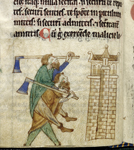
Firstly, the Irish are "barbarous..and cannot be said to have any culture. they are a wild and inhospitable people...they live on beasts only and live like beasts." Secondly, they are lazy, "think that the greatest pleasure is not to work and that the greatest wealth is to enjoy liberty." Gerald really gets into his stride with the third national trait, which is incest: "This is a filthy people, wallowing in vice." Fourth has us always treacherous, and he warns "You must be more afraid of their wile than their war." The fifth is the tendency to "always carry an axe as if  it were a staff...beyond being raised a little, it inflicts a mortal blow."  


Man killing another with an axe.
If only it were some nifty axe-work we were accused of. Gerald has more. He cites the example of a new and outlandish way of confirming kingship by the Irish in Ulster (where he never went). A white mare is brought before the ruler, who has intercourse with the animal, slaughters it, then boils up the meat and has a bath in the broth, "quaffs and drinks of it...in which he is bathed...just dipping his mouth into it round about him." 


Kingship ritual.
The Irish Church isn't spared either. Gerald despairs that all the Irish saints are "confessors and there is no martyr...to cement the foundation of the church with his blood, not a single one." 

Gerald ends by countering his earlier statements about handsome Irish people. Yes, there might be some. But he has never seen so many suffering from defects and "turn out in a horrible way."  What can the Irish expect? They are a people "that is adulterous, incestuous, unlawfully conceived and born, outside the law, and shamefully abusing nature herself in spiteful and horrible practices."

A disabled man. 
So positives no more, except for an unexpected section in the third part of the Topographia where Gerald acknowledges and praises the Irish as highly skilled and talented musicians. Mind you, even this is qualified with a statement that the Scots have probably overtaken them.

Woman with harp.

What to make of the Topographia, with its praise for a country but its condemnation of a people? Well, as I remarked at the start of this post, Gerald was on the side of the invaders. And if you make those you seek to conquer less than civilized, less than human, then you have the sword of justification in your hand. It's a very powerful weapon and has never been sheathed for very long in human history. The history of Ireland is no exception. The Topographia records some sadly prescient words to that effect, attributed by Gerald to Tatheus, Archbishop of Cashel in Ireland.

Gerald was bemoaning  to Tatheus the fact that the Irish had never produced a martyr. Tatheus replied: "But now a people has come to the kingdom which knows how, and is accustomed, to make martyrs. From now on, Ireland will have its martyrs, just as other countries."

Reading them with the hindsight of eight centuries of Irish history, these words are heartbreaking. And what did Gerald make of them? They were, according to him, "sly." 


Man carrying another.
~~~~~~~~~~~~
All images are in the Public Domain and are part of the British Library's Catalogue of Illuminated Manuscripts.
References:
Cosgrove, Art, ed: A New History of Ireland Volume II, Medieval Ireland: Oxford University Press (2008)
Duffy, Seán: Ireland in the Middle Ages: Palgrave Macmillan (1997)
Gerald of Wales: The History and Topography of Ireland: Penguin Clasics (1982)
Otway-Ruthven, A.J.: A History of Medieval Ireland: Ernest Benn Limited (1968)
~~~~~~~~~~~~~
Note: I originally posted this article or an edited version of it on English Historical Fiction Authors on March 17th 2015.


- See more at: http://www.bloggerhow.com/2012/07/implement-twitter-cards-blogger-blogspot.html/#sthash.Xcm5fXCr.dpuf