Tuesday, March 17

Medieval Ireland

Lá Fhéile Pádraig sona daoibh- Happy Saint Patrick's Day to you all! Yes, it's the day when much of the globe celebrates all things Irish by a) donning green and b) taking leave of their senses. Fair enough. As an Irish person, it's nice to see that the small island from which I hail is so widely/wildly celebrated, and I was very pleased that I could snag today's posting date to add to the acclaim.

Letter P Detail of decorated initial 'P'(lacuit). 
Much has been written about Ireland's history, but not many people are aware of a history of Ireland that was written in the 12th century, Topographia Hiberniae, or The History and Topography of Ireland. It was written by Gerald of Wales, a cleric and chronicler at the court of England's Henry II. (In case anyone's disappointed, please be assured that there will be snakes.) Gerald also included helpful illustrations: the manuscript images in this post are all his.

Partly Anglo-Norman and partly Welsh and a member of the hugely powerful and successful fitzGerald family, Gerald wrote seventeen books and planned several others. He wrote the Topographia following two visits to Ireland in 1183 and 1185. It is a remarkable work, shedding light on many aspects of medieval Irish life and society. However, it is at all times Gerald's light, and Gerald was on the side of the conquerors. Bearing that in mind, let's look at the Ireland of 850 years ago from a man who was there.

Initial 'L'(oqui) and a partially damaged map of islands
including Ireland (labelled 'Hybernia') and 'Britannia' 
Gerald divided his book into three parts. the first part he called The Position of Ireland. For the medievals, Ireland was the most westerly point in the world. Sorry, Americas, but there was simply nothing else. As Gerald so beautifully puts it: " Beyond these limits, there is no land, nor is there habitation either of men or beasts- but beyond the whole horizon only the ocean flows and is borne on in boundless space." He describes Ireland as about half the size of "greater Britain and ...more round."

Ireland's natural resources greatly impressed Gerald. He writes of rivers of magnificent size, with their "abundance of fish...beautiful lakes full of fish of magnificent size...a kind of speciality here." 

Detail of a miniature of an osprey diving for fish.
The fertile land and the mild temperatures, along with the ease with which grass could be grown also pleased Gerald: "The grass is green in the fields in winter, just the same as in summer." But like so many visitors to Ireland, Gerald quickly found out what made all that green in the first place: the Irish weather. (Or as we natives like to call it, the rain.) Gerald is not happy: "[The harvest] can scarcely be reaped...because of the unceasing rain. For this country more than any other suffers from storms of wind and rain... There is such a plentiful supply of rain, such an ever-present overhanging of clouds and fog, that you will scarcely see even in the summer three consecutive days of really fine weather." 


Snake!
Gerald was cheerier about the plentiful supply of birds and the lack of mammals that would pose a threat to man. He even mentions snakes, (I did promise), or rather, lack of them. He assures us that "Ireland has no serpents or snakes, toads or frogs, tortoises or scorpions."  His readers will also have been relieved to know "It has no dragons." For those of you waiting to see if Gerald has the definitive answer on Saint Patrick and the snakes issue, Gerald provides one. But you may be disappointed: "Some indulge in the pleasant conjecture that Saint Patrick...purged the island of all harmful animals. But it is more probable that from the earliest times...the island was naturally without these as well as other things." 


Spider
The first part of the Topographia is a wonderful read, in that so much of it is recognizable as the Ireland that still exists. The second part is also remarkable but in a way that is less based in reality. In it, Gerald relates The Wonders and Miracles of Ireland.

Fish & Deer With Golden Teeth.
Under Wonders, we have reports of a small island where corpses don't rot. A bearded woman with a mane on her back at the court of the King of Limerick. A priest who conversed at length with a wolf. A whale that was found with three gold teeth. Wonders, indeed, but the lake that was formed in a flood because the people were addicted to bestiality is probably the show stopper.

Women mating with animals.
Moving swiftly onto Miracles, Gerald includes (among many others), the fleas banished by Saint Nannan, a cross in Dublin that speaks the truth and the inextinguishable fire of Saint Brigid. My personal favourite is The Mill that Women Do Not Enter. The mill in question was carved by Saint Féchín, and women weren't allowed in. But an archer of Hugh de Lacy (de Lacy was Henry's man) dragged a woman in "and lustfully violated her there."  Happily, according to Gerald, the archer was "stricken in his member with hell-fire in sudden vengeance and immediately began to burn throughout his whole body. He died that same night." Good for Saint Féchín, I say. 


A stag, a hare, a badger & a beaver. 
The third part of the Topographia is where Gerald gets up close and extremely personal with the Irish people. Its title is The Inhabitants of the Country. One gets a sense of what is to come when he begins it by restating the legitimate claim that the kings of Britain have over Ireland. Following a brief mention of "beautiful, upright bodies and handsome and well-complexioned faces", there are positives no more.

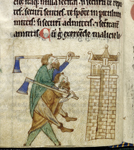
Firstly, the Irish are "barbarous..and cannot be said to have any culture. they are a wild and inhospitable people...they live on beasts only and live like beasts." Secondly, they are lazy, "think that the greatest pleasure is not to work and that the greatest wealth is to enjoy liberty." Gerald really gets into his stride with the third national trait, which is incest: "This is a filthy people, wallowing in vice." Fourth has us always treacherous, and he warns "You must be more afraid of their wile than their war." The fifth is the tendency to "always carry an axe as if  it were a staff...beyond being raised a little, it inflicts a mortal blow."  


Man killing another with an axe.
If only it were some nifty axe-work we were accused of. Gerald has more. He cites the example of a new and outlandish way of confirming kingship by the Irish in Ulster (where he never went). A white mare is brought before the ruler, who has intercourse with the animal, slaughters it, then boils up the meat and has a bath in the broth, "quaffs and drinks of it...in which he is bathed...just dipping his mouth into it round about him." 


Kingship ritual.
The Irish Church isn't spared either. Gerald despairs that all the Irish saints are "confessors and there is no martyr...to cement the foundation of the church with his blood, not a single one." 

Gerald ends by countering his earlier statements about handsome Irish people. Yes, there might be some. But he has never seen so many suffering from defects and "turn out in a horrible way."  What can the Irish expect? They are a people "that is adulterous, incestuous, unlawfully conceived and born, outside the law, and shamefully abusing nature herself in spiteful and horrible practices."

A disabled man. 
So positives no more, except for an unexpected section in the third part of the Topographia where Gerald acknowledges and praises the Irish as highly skilled and talented musicians. Mind you, even this is qualified with a statement that the Scots have probably overtaken them.

Woman with harp.

What to make of the Topographia, with its praise for a country but its condemnation of a people? Well, as I remarked at the start of this post, Gerald was on the side of the invaders. And if you make those you seek to conquer less than civilized, less than human, then you have the sword of justification in your hand. It's a very powerful weapon and has never been sheathed for very long in human history. The history of Ireland is no exception. The Topographia records some sadly prescient words to that effect, attributed by Gerald to Tatheus, Archbishop of Cashel in Ireland.

Gerald was bemoaning  to Tatheus the fact that the Irish had never produced a martyr. Tatheus replied: "But now a people has come to the kingdom which knows how, and is accustomed, to make martyrs. From now on, Ireland will have its martyrs, just as other countries."

Reading them with the hindsight of eight centuries of Irish history, these words are heartbreaking. And what did Gerald make of them? They were, according to him, "sly." 


Man carrying another.
~~~~~~~~~~~~
All images are in the Public Domain and are part of the British Library's Catalogue of Illuminated Manuscripts.
References:
Cosgrove, Art, ed: A New History of Ireland Volume II, Medieval Ireland: Oxford University Press (2008)
Duffy, Seán: Ireland in the Middle Ages: Palgrave Macmillan (1997)
Gerald of Wales: The History and Topography of Ireland: Penguin Clasics (1982)
Otway-Ruthven, A.J.: A History of Medieval Ireland: Ernest Benn Limited (1968)
~~~~~~~~~~~~~
Note: I originally posted this article or an edited version of it on English Historical Fiction Authors on March 17th 2015.


Saturday, February 14

Medieval Saints and Lovers

I write historical thrillers and have long had a fascination for all things medieval. One of the aspects of medieval life that has always intrigued me has been people’s devotion to saints. I’ve touched on other blog posts, where I looked at saints' relics.

Medieval Saint Valentine
Public Domain
Hang on a minute, I hear you say. This blog is for Valentine’s Day, for lovers. Should I be looking at preserved body parts here? I think not. But I would like (like our medieval forebears would have) to look at the saints that might appeal to us at this time when all thoughts turn to love. You might be surprised by the findings.

Let’s kick off with the saint who names the day. Saint Valentine himself. As with many saints, the origins of who he was (and there is evidence there may have been three saints) are vague. But don’t expect him to have been elevated to sainthood because of any kind of special involvement with lovers.

Valentine was a holy priest in third century who helped out persecuted early Christians. He was arrested and tried before the prefect of Rome. The prefect tried to make him renounce his faith but Valentine refused. The prefect ordered Valentine be beaten with clubs, which still didn’t make him change his mind. He was then beheaded. His execution took place on February 14, about the year 270. Interesting that the record is clear about the date being February 14, but a bit hazy about the year.

This can be explained when we fast forward to medieval times.  The concept of courtly love with aloof, desirable women was hugely popular during this period. Troubadours celebrated these women through song and poems. In the fourteenth century, Geoffrey Chaucer brought the popularity of courtly love to new heights with his poem The Parlement of Fowles.

Alain Chartier
Edmund Blair-Leighton, 1903
Public Domain
This poem first introduced the idea of Valentine’s Day being a day for lovers. The Cour Amoreuse was founded in the French Medieval Court, supposedly in honour of women. It first met on Valentine’s Day in 1400, ruled over by a ‘Prince of Love’ who was a professional poet. Noble ladies heard various love-poems and presented prizes to the winners.

But what’s interesting is that in the canon of Catholic saints, Saint Valentine isn’t the saint of wistful lovers in the throes of a new romance. He is the patron saint for those who have already found their perfect partner.

Being the patron for those seeking love actually belongs to the Archangel Raphael. Saint Raphael, according to legend, helped Tobias enter into marriage with Sarah, who had seen seven previous bridegrooms perish on the eve of their weddings. (That has to be a run of bad luck if there ever was one.) Saint Raphael is the patron saint for what is called happy encounters (how sweet!).

The Angel Raphael
leaving the family of Tobias
Rembrandt, 1637
Public Domain
You could of course always try the Welsh Saint Dwynwen. She is the Welsh patron saint of love and friendship, who lived during the fifth Century and was one of the 24 daughters of King of Wales, Brychan Brycheiniog. (When I came across those statistics, I felt perhaps that Brychan should patron saint of something, but I wasn’t quite sure what).

© Copyright Robin Drayton
http://www.geograph.org.uk/

Dwynwen founded a convent on Llanddwyn, on the west coast of Anglesey, where she was joined by other broken-hearted women. After her death in 465AD, a well named after her became a place of pilgrimage and it remains there today.

There are also of course related saints: Saint Agnes, patron saint of virginity. Saint Anne, the patron saint of fertility and childbirth and Saint Gerard Majella, patron saint of motherhood, both good to call on when Saint Agnes has gone off duty. And of course, good old Saint Fotino, the patron saint of erectile dysfunction, who has a reassuring big white beard, but alas, I couldn't find a usable image.

St. Agnes
Caesare Dandini, 16th C
Public Domain
So, lovers of love, you are not restricted to just Valentine on February 14. You can take your pick of saints- just like the medievals did.

Friday, February 6

The Medieval Romances of Chrétien de Troyes


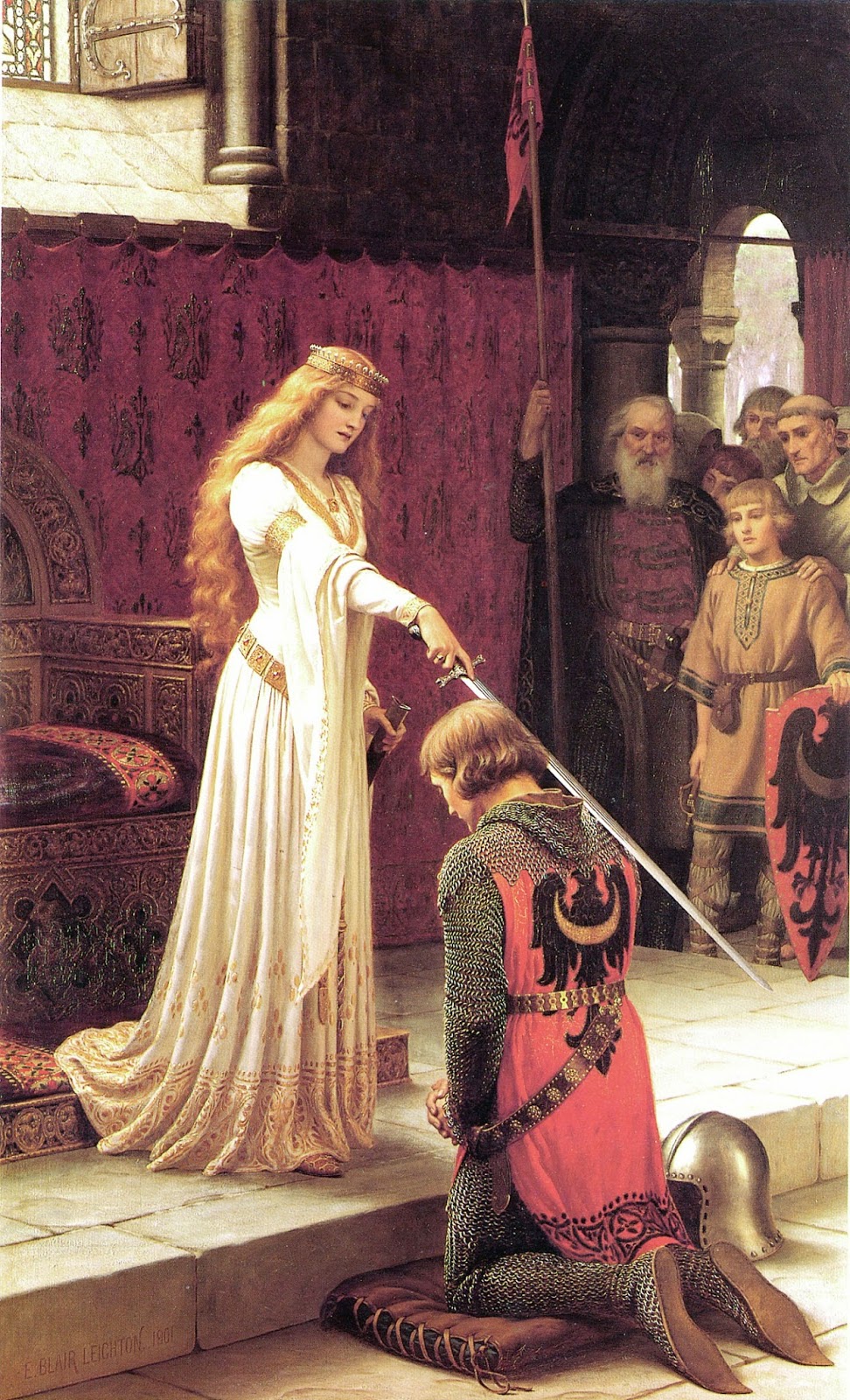
The Accolade
Edmund Blair Leighton, 1901
Public Domain
If I were to ask you if you knew the story of Sir Lancelot, then I suspect you would answer in the affirmative. Chain mail. One of King Arthur’s knights. Caused all sorts of bother with Guinevere. Yes, you know all about him. But if I were to ask you who Chrétien de Troyes was, you might not have such a ready answer. It might surprise you to know that he is the medieval writer credited with bringing the legend of said Sir Lancelot along with the other Arthurian legends into the genre known as romance. And of course, writing about a British king, Chrétien was French.

It is frustrating that we know very little of Chrétien’s life. He was writing between 1160 and 1172, and it is suggested that he had a position as herald-at-arms at the court of his patroness in the city of Troyes. His patroness was the Countess Marie de Champagne, daughter of Louis VII and Eleanor of Aquitaine. Familiar to us all will be the notion of Courtly Love: this was also a concept running through Chrétien’s work.

Marie played a major part in taking this romantic ideal and promoting it as fashionable behaviour. Devotion and courtesy featured, but so did adulterous love. It should be remembered that adultery was considered amongst the gravest of sins by the medieval church. But Marie’s influence, and perhaps that of her mother, created a surge of interest amongst European aristocracy. (One commentator describes her as ‘this celebrated feudal dame’, a description which, to my eternal regret, conjured up a medieval Mae West on first reading.)

The End of the Song
Edmund Blair Leighton, 1902
Public Domain

Chrétien wrote in Old French, rather than Latin. He composed at least five romances and two lyric poems. The word ‘romance’ also comes to us from this period. The Old French word romanz was first used in a literary sense to distinguish words written in vernacular French (romanz) from those in Latin.

So how did Chrétien happen on tales of King Arthur for inspiration? It would seem that Chrétien, like all good writers of historical fiction, liked a bit of a borrow from the past. Irish, Welsh and Breton legends have some mentions. Geoffrey of Monmouth’s Historia regum Britanniae, written in 1137, introduced the Arthurian legend to continental Europe.  This was a Latin history written in prose. Anglo-Norman poet Wace produced Roman de Brut in 1155, a version of the history now in French couplets.

King Arthur & the Knights of the Round Table
Michael Gantelet, 1472
Public Domain

Wace’s King Arthur and his knights of the Round Table (Wace’s is the first known mention of the Round Table; Chrétien has that for Camelot) were undoubtedly a more refined bunch than those written of previously. But they were still a group of fighters, rather than lovers. If his version were a historical novel, it would have swords and sandals on the cover, no question. It would take Chrétien to bring on the cover with the headless lady in the big dress.

In Chrétien’s romances we have knights riding out on adventures, fighting bravely against other warriors, monsters and magical creatures. And of course, the knights are also in pursuit of the love of their fair lady, often a love they lose, only to fight to get it back again. This latter storyline might be familiar to readers of the contemporary romance genre. But forget stereotypical images of swooning ladies.  Chrétien doesn’t hold with damsels in distress. His ladies can be just as courageous and daring as his knights. When one considers the powerful woman that was one of Chrétien’s patrons, along with other powerful female patrons, this is hardly surprising.

God Speed!
Edmund Blair Leighton, 1900
Public Domain

So what of the romances? First is Erec et Enide, with its straightforward tale of love, estrangement and reconciliation on an adventure-filled journey. It is set in Brittany and depicts King Arthur sitting on a throne emblazoned with a leopard. Such court scenes may have been inspired by Henry II’s  Christmas 1169  court at Nantes in Brittany.

Second is Cligès, which is written against the background of the Tristan and Iseut story. It is an adulterous tale in which Cligès falls in love with Fenice, his uncle’s wife. She feigns her death with a magic potion, so they can be together.

Third up is Lancelot, or The Knight with the Cart. By far the most famous romance of Chrétien’s, it is the first tale of the adulterous love between Lancelot and Queen Guinevere. Though she is cruel to him, he obeys her every command and wish. Readers may not be familiar with its name, The Knight with the Cart. It is so called because in his search for Guinevere, Lancelot rides in a cart meant for convicted criminals. He is concerned for his honour (albeit briefly), but she is very displeased that he would hesitate in his search for her.

The Parting of Sir Lancelot & Guinevere, 1874
Julie Margaret Cameron
Public Domain

Fourth is Perceval, a very lengthy yet not completed tale. Again, it introduces a story which has inspired so many, many more tales of searches and quests: the quest for the Grail.

Last, but by no means least, we have Yvain, or The Knight with the Lion. It is a spectacular romance and adventure, with a lion, a giant, a magic fountain and the widow who falls in love with Yvain, her husband’s killer.

In Time of Peril
Edmund Blair Leighton, 1903
Public Domain

Lancelot and Guinevere. The Grail. King Arthur. Camelot. Chivalrous knights. All part of the popular cultural imagination, thanks to Chrétien de Troyes. We may not know much about him. But my goodness: we know about his stories. We are still retelling them today.

References:
De Troyes, Chretien: Arthurian Romances, Penguin Classics (1991)
Encyclopaedia Brittanica: Chrétien de Troyes
Jones, Terry & Eriera, Alan: Medieval Lives, BBC Books (2004)
Lindahl, C., McNamara, J & Lindow, J. (eds.): Medieval Folklore, Oxford University Press (2002)
Norton Anthology of English Literature: Chrétien de Troyes: www.norton.com
Weir, Alison: Eleanor of Aquitaine: By the Wrath of God, Queen of England, Vintage Books (2007)

Note: I originally posted this article on English Historical Fiction Authors on February 1st 2015.
~~~~~~~~~~~~~


Monday, December 29

The Murder of Thomas Becket

Midwinter in England can indeed be bleak. Iron-hard frosts, smothering snow, torrential rain and gales: all can sweep down on these short days where daylight is gone by mid-afternoon. But at day's close on the twenty-ninth of December 1170, an event occurred that stunned medieval England and all of Christendom. Archbishop Thomas Becket was brutally murdered by four knights in his own cathedral at Canterbury. The knights came to Canterbury following an outburst by Henry II, king of England and much of France. It was a tragedy that had been set in motion many years before.

Canterbury Cathedral
© Shane Broderick Photography 

The son of a London merchant, Becket cut an imposing figure. He was over six feet tall (well above average for the period), with an aquiline nose, a "large brow", and "long and handsome face". He had a quick mind and a particular capacity to absorb and retain huge amounts of information. One chronicler states that he could even detect and react to distant smells and scents! Though he had stammered in his youth, he largely overcame this and was a fluent orator.

Appointed as Henry's Chancellor in 1155, Becket did not disappoint the King. He performed brilliantly in the role and the two men, Henry thirteen years younger than Becket, became extremely close. William Fitzstephen records "Never in Christian times were there two greater friends, more of one mind."


Henry makes Becket Archbishop of Canterbury
Liturgical comb c. 1200
© 2014 E.M. Powell 

One mind, perhaps, but of course Henry was king. And he was a king who was engaged in power struggles with Rome. On the death of Archbishop Theobald in 1161, Henry appointed Becket as Archbishop of Canterbury, believing Becket would simply do his bidding and act at all times on his behalf. Henry could not have been more wrong. Becket stood firm against Henry in matters of ecclesiastical law and power. Their disputes dragged on until in 1170 Henry had his son anointed as king by the Archbishop of York, a ceremony that was witnessed by ten other bishops. Becket's response? He excommunicated the bishops from the pulpit at Canterbury Cathedral on Christmas Day. When news reached Henry, he went into one of his legendary rages.

And his rages were indeed legendary. Henry could really let rip when roused. According to John of Salisbury, Henry once became so enraged during a debate about the King of Scotland that he flung off many of his clothes and started "chewing on pieces of straw." John also has Henry describing himself as "a child of anger." One of Henry's charters states that if anyone "should attempt to quash...this grant, he will incur the disfavour, anger and indignation of Almighty God and me."

Canterbury Cathedral
© Shane Broderick Photography 

So it was when Henry was informed of the news of Becket's latest actions. He "struck his hands together and exclaimed against it vehemently", his face "white with fury." His tirade against Becket was about the man's ungratefulness, too: he had raised Becket to a high position, and the only response was treachery. He worked himself up to a frightening pitch, ending with the words: "He has...shamed my realm; the grief goes to my heart, and no-one has avenged me!" Unfortunately, a group of barons who were listening took him at his word. They set off for Canterbury to avenge their king.

And who were these knights? It is unlikely they were part of Henry's intimate circle and acted to increase their favour with the king. William of Canterbury gives us their names and their descriptions. First was Reginald Fitzurse. "Urse" means "bear", and William claims the name indicated the man's savagery. Hugh de Morville's surname translates as "a village of death." William de Tracy is acknowledged as a brave fighter, but had a "sinful way of life." Richard le Bret became the Brute "on account of the depravity of his life." It was these who headed for the cathedral in which the holy man they sought was to be found.

Canterbury Cathedral
© Shane Broderick Photography 
The accounts of events from eight hundred and forty four years ago can often be sketchy. In the case of Becket's murder, we have detail upon appalling detail, as five monks were eye-witnesses to it and wrote their version.

When the knights arrived at Canterbury Cathedral, daylight was fading. They first took off their armour and went to confront Becket who was in the Episcopal Palace. They most likely had come to arrest him but Becket simply refused to comply. That did not help the situation. The knights went back out and started to put on their armour once more. The monks and clerks who were with their Archbishop were extremely concerned by now for Becket's safety. Even if no-one expected murder, they were aware that Becket could be hideously maimed or wounded in such a tense situation. No doubt Becket himself was also aware that this was now a very real possibility. The monks hustled him through to the Cathedral, though he protested throughout.

Carrying on with the rhythm of the day, the Office of Vespers was being sung, the monks voices echoing into the cathedral's high roof with the only light from candles or lamps. Such illumination would hardly have  pierced the chill darkness and cast instead deep shadows. Once the monks saw Becket, they halted their prayers, rejoicing that he was safe. It was only a temporary reprieve. As he walked to the altar, the knights burst in, armed with hatchets and an axe, Fitzurse yelling "Where is the archbishop, the traitor of the King?"

The Murder of Thomas Becket
Public Domain

Becket kept his composure, replying: "Here I am, not a traitor of the King, but a priest. Why do you seek me?" The knights were not so calm. They surrounded Becket, in a shouting, clamouring group, their lethal weapons ready and raised. Grabbing hold of Becket, they tried to manhandle him away but he grabbed for one of the stone pillars and refused to move. Then the Archbishop delivered an insult to Fitzurse, calling him a panderer or a pimp and challenged Fitzurse to kill him. This seemed to tip Fitzurse over into murderous rage, and he roared at de Tracy to strike. Becket bent his head in submission. He knew he was going to die.

Chasse showing the Martyrdom of Saint Thomas Becket c1190
© 2014 E.M. Powell 

De Tracy's first strike took off the top of Becket's skull and glanced off, injuring Brother Edward Grim. The watching appalled monks fled in panic, as Becket took another blow to the head but still remained standing. He must have been in unspeakable agony and shock, yet managed to speak for the last time: "For the name of Jesus and the good of the Church, I am ready to embrace death." De Bret thrust his sword through Becket's head with such force that the sword shattered on the altar stone. A cleric who had accompanied the knights scattered the Archbishop's brains, declaring, "He won't get up again." It was over. The knights left the cathedral and went to the Episcopal Palace, where they ransacked Becket's possessions.

Becket's body lay cooling on the altar as the traumatized monks made their way back in. Over the next few hours, people converged on the cathedral in horrified disbelief. Those who came dipped their fingers in the blood of their martyred Archbishop, daubed their clothes with it, and collected as much as they could. Terror still filled the air, with rumours flying around that the murderers were coming back to take the body, or to slay others. It was feared that the knights would defame Becket's corpse, and pull it across the city behind a horse, or display it on a gibbet. This could not be countenanced. The monks decided to bury Becket in the crypt as quickly as possible.

Canterbury Cathedral
© Shane Broderick Photography 

The miracles began that very night. A man who dipped part of his shirt into Becket's blood went home to his paralysed wife. As he wept in his telling of the murder, she asked to be washed in water containing some of the blood. She was cured immediately. A shrine was erected to Becket in the cathedral. An astonishing 100,000 people came to pray and visit Canterbury Cathedral in 1171 alone. The attributed miracles mounted up and in ten years, there were a total of 703 recorded. Becket’s intercession was in healing, casting out demons. He was prayed to by women in childbirth. When Queen Eleanor, the wife of King Henry III was expecting her fourth child, 1,000 candles were lit around Becket’s shrine.

Reliquary casket with scenes of the martyrdom c1173-80
© 2014 E.M. Powell 

And what of Henry, the king whose supposed utterance of "who will rid me of this meddlesome priest?" set the murder in motion? Henry had to give in on the matter of church courts. He also performed a number of acts of penance for the man who had once been his dear friend. The most extreme was on the streets of Canterbury on 12 July 1174, where he was scourged by eighty monks before spending the night praying at Becket’s tomb. (You can read my post on those events here.) In death, Becket had been victorious.

Canterbury Cathedral
© Shane Broderick Photography 

Saint Thomas Becket was a venerated saint for the next four hundred years. Until the arrival of another King Henry, Henry VIII. This Henry was going to take on the church. And win. When he achieved his aim of total control of the church, Henry VIII denounced Becket as a traitor. Becket’s shrine was destroyed, his bones were burned and the mention of his name was outlawed.

Canterbury Cathedral
© Shane Broderick Photography 

But Henry didn’t manage to erase the memory of Becket. People continued in their devotion to him as a saint. Today, Canterbury Cathedral still marks the place of Becket’s martyrdom and thousands continue to visit every year. Think of him today, at day’s close.

References:
Photographer Shane Broderick specializes in studies of castles, churches and places of pilgrimage. To view more and to see his other work, please visit his Facebook Page at Shane Broderick Photography. You can also view his video here for more on Canterbury Cathedral. His photographs on this post have been used with his generous permission.

Abbott, Edwin A.: St. Thomas of Canterbury: His Death and Miracles, A & C Black (1898)
Cathedral: Murder at Canterbury, BBC TV (2005)
Gervase of Canterbury: Thomas Becket's Death, from History of the Archbishops of Canterbury, Internet Medieval Sourcebook, Fordham University
Grim, Edward: The Murder of Thomas Becket, Internet Medieval Sourcebook, Fordham University
Guy, John: Thomas Becket, Penguin Books (2012)
Jones, Dan: The Plantagenets: The Kings Who Made England, William Collins, (2013)
Staunton, Michael (ed.): The Lives of Thomas Becket, Manchester University Press (2001)
Warren, W.L., Henry II, Yale University Press (2000)
Weir, Alison: Eleanor of Aquitaine: By the Wrath of God, Queen of England, Vintage Books (2007)
~~~~~~~~~~~~~~~~~
I first wrote this post or an edited version of it for the English Historical Fiction Authors blog in December 2014.

Monday, November 3

Medieval Sorcery

At this time of year, there is much talk of witches, with large numbers of people happy to don a pointy black hat and party hard. Medieval people would have been unlikely to join in. The matter of anyone who practised magic was complex and they would have recognised the concept of a sorcerer rather than a witch.

Medieval Devil
© E.M. Powell
In medieval Europe two forms of magic existed: natural and demonic. Natural magic used the hidden powers in nature, helping with cures and protection. Demonic magic was a perversion of religion, practised it was believed by those who had turned away from God and instead to the devil. It was the practise of sorcerers.

The Practice of Sorcery

It was a widely-held belief that sorcerers could curse somebody with words, leading to illness or death. Sorcerers were also thought to be able to cause animal death, crop failure or an adverse change in the weather. The evil words could be a corrupted blessing, or a simple appeal to the devil. The supposed victim was not usually present at the utterance of curses.

The Prince of Devils sends out his ministers
 c1325 British Library 
Far more useful evidence to those making accusations of demonic magic were physical objects left on or near their property by the sorcerer. These objects were considered to have magical properties that could inflict harm. They could include animal bodies, mysterious powders, human faeces or even wood from a gallows. Poisoned food was also a frequent accusation.

In 1326, Pope John XXII wrote in his letter, Sorcery and the Inquisitors, of many objects that could serve the sorcerer’s purpose:  ‘Grievingly we observe…that many who are Christian in name only…sacrifice to demons, adore them, make or have made images, rings, mirrors, phials, or other things for magic purposes and bind themselves to demons.’

He had experienced several attempts on his life, including one by poison and alleged sorcery.

© E.M. Powell
There are also records of image magic. A sorcerer in fourteenth century Coventry was accused of making a wax image of a neighbour, sticking spikes into it that caused the man to go mad with a pain in his head and finishing him off by driving the spike through the image’s heart.

It was widely believed that impotence or lack of sexual desire was caused by sorcery. If a man consumed forty ants boiled in daffodil juice, then lifelong impotence would follow. Physician Arnold of Villanova wrote a treatise On Bewitchments around 1300 in which he gave numerous remedies. They include ‘fumigation of the bedchamber with the bile of a fish and smearing the walls with the blood of a black dog.’ That would indeed provide a certain ambience to a love nest.

A devil carries off the soul of a dying lover.
c1325 British Library 
Sorcerers

Some accounts of medieval sorcery are on a far grander scale.

Guibert of Nogent, writing around 1115, gives details of the heretics of Soissons. Meeting in underground chambers, they would light candles and then do something unmentionable to naked women with them. Indiscriminate sexual intercourse then took place. Any babies born from these acts were then allegedly burned at later meetings and their ashes baked into bread which was eaten. The strong overtones of blasphemy in this account are very clear.

William of Malmesbury (d 1142) wrote an account of the Sorceress of Berkeley, who had died in 1065. He describes her as ‘a woman addicted to sorcery…skilled in ancient augury, she was excessively gluttonous, perfectly lascivious, setting no bounds to her debaucheries.’ She repented on her death bed and begged for her body to be saved from Satan, with her corpse sewed up in a stag’s skin, placed in a stone coffin and weighted with lead and iron and secured with chains. It was no good. A devil broke into the church and made off with her on the back of a barbed black horse.

A hermit and a devil
c1275-1325 British Library 
The legend of the Sorceress of Ryazan dates from 1237. At Ryazan, a town on the eastern border of medieval Russia, a ‘woman of astonishing ugliness’ arrived with other riders on a snowy morning, demanding tithes. She was spurned. A few months later, a horde of murdering Mongols sacked the town.

Sorcery Trials and Punishment 

Secular laws and Church laws/canons attempted to tackle the problem of sorcery, and mutually influenced each other.  Secular laws dealt with the crime of magic and attempted to address harm done to people by magic.

Penalties included execution. The Church could order penance for the sin of magic and/or could excommunicate the offender. Excommunication, with the threat of eternal condemnation to hell, was as terrifying as a death sentence.

From Sorcery to Witchcraft

A sermon preached by Bernardino of Siena 1427 encourages people to cry out ‘To the flames! To the flames!’ if someone offers to cure the sick with magic. He also encouraged people to report sorcery, because if they did not, they shared in the guilt.

© E.M. Powell
Sorcery trials increased in the fourteenth century, but the latter half of the fifteenth century saw a dramatic increase. Heinrich Kramer published Malleus Maleficarum (Hammer of Witches, c 1486), the most important medieval treatise on witchcraft. It strongly emphasised the demonic element in sorcery and (tragically) the conspiratorial nature of witchcraft.

Medieval sorcery was evolving into witchcraft. And in its name, around 50,000 women and men were executed by burning at the stake or hanging from the fifteenth to the eighteenth century.

How interesting that John of Salisbury, (d 1180) secretary to Archbishop Thomas Becket, wrote in 1154 of ‘the belief in evil nocturnal assemblies, where infants are murdered and eaten by witches. Such beliefs also state that the infants are granted mercy by the witch-ruler, who returns them unharmed to their cradles. Who could be so blind as not to see in all this a pure manifestation of wickedness created by sporting demons?’ 

Demons tempting people with dancing
c1325 British Library
He answers his own question with a great deal of sense:
‘Indeed, it is obvious from this that it is only poor old women and the simpleminded kinds of men who enter into these beliefs.’

What a tragedy that his view did not prevail.
~~~~~~~~~~~~~~
If you've enjoyed this post, then you'll enjoy my historical thriller, The Blood of The Fifth Knight. It is published in German as Das Blut des fünften Ritters. And yes, accusations of sorcery are made with horrific consequences.


References:
All images unless otherwise stated are in the Public Domain and are part of the British Library's Catalogue of Illuminated Manuscripts. 

Kieckhefer, Richard: Magic in the Middle Ages, Cambridge University Press (2000)

Kelly, John: The Great Mortality, Harper Perennial (2006)
Kors & Peters (eds.): Witchcraft in Europe 400-1700, University of Pennsylvania Press (2001)
Lindahl, C., McNamara, J & Lindow, J. (eds.): Medieval Folklore, Oxford University Press (2002)
Maxwell-Stuart, P.G.: Witchcraft- A History, Tempus Publishing Limited (2004)
~~~~~~~~~~~~~~
I wrote this post (or an edited version of it) for English Historical Fiction Authors on November 02 2014.

Thursday, October 16

Fair Rosamund, Mistress of Henry II

In The Blood of the Fifth Knight, my second medieval thriller with Sir Benedict Palmer, somebody is trying to murder the Fair Rosamund, the beautiful young mistress of King Henry II. Henry summons Palmer to find out who is responsible. Events do not, of course, go to plan. But I really enjoyed writing the character of Rosamund, although little is known about the real woman. Here are some of the facts and the myths about her. 

Fair Rosamund
John William Waterhouse, 1916
Public Domain
King Henry II has a deserved infamous reputation for extra-marital affairs. Documented evidence exists of several liaisons, some of which produced illegitimate offspring, with women rewarded financially for their services to the King. By far the most well-known of Henry's mistresses is Rosamund Clifford, the young woman who is often referred to as Fair Rosamund. A less flattering contemporary description comes from Gerald of Wales, Henry's acerbic chronicler, who refers to her as 'that rose of unchastity.'

Her story has been embellished by layers of myths and legends over the last eight centuries. Born to Sir Walter de Clifford, a knight who had served Henry faithfully, Rosamund may have begun her affair with Henry at a very young age. The affair became open and public in 1174 when Henry had imprisoned his wife, Eleanor of Aquitaine, for her part in a rebellion against him. Later chroniclers mistakenly claimed that Rosamund bore Henry children, but there is no evidence that she did so.

Fair Rosamund in her Bower
William Bell Scott, after 1854
Public Domain
The bearing of children is one of the tamer stories that grew up around Rosamund. Ranulf Higdon, monk of Chester, born almost a century after her death, claimed that Henry had built pleasure gardens and a labyrinth or a maze for her at Woodstock in Oxfordshire. There is no evidence of such structures at the site which is located near Blenheim Palace. The spring and pond known as Rosamund's Well were not part of the buildings at Woodstock when Rosamund lived there.

Rosamund's Well today. The well is beside the lake in Blenheim's Great Park.
  © Copyright Philip Halling Creative Commons Licence

But that didn't stop the rumour factory of popular imagination. A further embellishment was that Rosmund had been murdered by Eleanor, who had found her in the maze.

Thomas Deloney, a renowned writer of  popular ballads who died about 1600, wrote 'The Ballad of Fair Rosamond'. An edition in circulation between 1658 and 1664 is titled: 'A mournful ditty of the lady Rosamond, king Henry the seconds concubine, who was poysoned to death by Queen Elenor in Woodstocst [sic] bower near Oxford.'

Poet Samuel Daniel wrote 'The Complaint of Rosamond' in 1592 and dedicated it to his wealthy patron, Mary, Countess of Pembroke. Again, the myth of Eleanor poisoning Rosamund endures, with Rosamund uttering such lines in the poem as;

‘And after all her vile reproches used,
She forc'd me take the poyson she had brought...
The poysoon soone disperc'd through all my vaines,
Had dispossess'd my living sences quite.’

Fair Rosamund & Queen Eleanor
Edward Burne-Jones, 1861
Public Domain

There continued to be numerous references to Eleanor carrying out the ghastly murder of Rosamund. As well as poisoning, there was stabbing, burning, bleeding and doing something unmentionable with toads. In Alfred, Lord Tennyson's play, Becket, Rosamund becomes the reason for Archbishop Thomas Becket's murder in Canterbury Cathedral. 

La Normandie, Jules Janin
Public Domain
Rosamund's life certainly was cut short. She died at Godstow Nunnery in Oxford in 1176 to where she had retired. The cause of her death is not known. Henry paid for a highly decorated tomb to be erected before the altar at Godstow. The records also show Sir Walter de Clifford making grants of 'several mills and a meadow' to Godstow in memory of his wife and daughter.

Godstow Nunnery today
© Copyright Pierre Terre and licensed for reuse under  Creative Commons Licence
Henry's generosity continued after his death in 1189. Bishop Hugh of Lincoln visited in 1191 and found the tomb still adorned with silk cloths and looked after by the nuns in accordance with Henry's wishes. Bishop Hugh, however, took a rather dim view of what he found. He ordered the removal of Rosamund's tomb to the nearby cemetery for 'she was a harlot.'

Fair Rosamund
Dante Gabriel Rossetti, 1861
Public domain
It was finally destroyed during Henry VIII's Dissolution. But even Henry VIII couldn't succeed in wiping out the memory of Fair Rosamund. Her myths endure to this day.
~~~~~~~~~~~~~~~~~

References and sources:

Archer, T.A., rev Hallam, Elizabeth, Oxford Dictionary of National Biography (Oxford University Press 2004-2014)
British History Online: www.british-history.ac.uk
Broadside Ballads Online- from the Bodleian Library: http://ballads.bodleian.ox.ac.uk/
Daniel, Samuel: 'Delia. Contayning certayne Sonnets: vvith the complaint of Rosamond.' 
Guy, John: Thomas Becket, Penguin Books (2012)
The Poetry Foundation: www.poetryfoundation.org
Warren, W.L., Henry II, Yale University Press (2000)
Weir, Alison: Eleanor of Aquitaine: By the Wrath of God, Queen of England, Vintage Books (2007)

I first published this post, or an edited version of it, on the English Historical Fiction Authors blog in October 2014. English Historical Fiction Authors: Fair Rosamund, Mistress of Henry II:

~~~~~~~~~~~~~~~~~~~~~~~~


- See more at: http://www.bloggerhow.com/2012/07/implement-twitter-cards-blogger-blogspot.html/#sthash.Xcm5fXCr.dpuf